

Research Progress
Universal Magnetocaloric Scaling Functions in Copper Sulfate Crystals near a Quantum Critical Point
A team led by Prof. Gang Su and Prof. Wei Li from the Institute of Theoretical Physics, Chinese Academy of Sciences (CAS), in collaboration with researchers from the Institute of Physics, Beihang University, Fudan University, and other institutions, has made important progress on the fundamental problem of universal thermodynamic scaling laws near quantum critical points, motivated by the frontier demand for extreme refrigeration. Working with the most common blue crystal—copper sulfate pentahydrate (CuSO4·5H2O)—the team measured, for the first time, the universal magnetocaloric scaling functions near a quantum critical point, established its complete magnetic field-temperature phase diagram, and achieved ultimate cooling down to 12.8 millikelvin without helium-3. These results were published on September 9, 2026 in Reports on Progress in Physics (IOP Publishing) under the title “Measuring universal magnetocaloric scaling functions near quantum critical point.”
Copper sulfate pentahydrate, also known as blue vitriol or chalcanthite, is one of the most common crystals in the world. Easily obtained and readily grown into large single crystals (Fig. 1a), it also possesses distinctive low-temperature thermal and magnetic properties that have made it central to several major scientific discoveries. In 1912, Laue performed the first X-ray crystal diffraction experiment on copper sulfate crystals (Nobel Prize in Physics, 1914, see Fig. 1b); in 1950, Bloembergen observed the first nuclear magnetic resonance (NMR) signal in a magnetic solid on copper sulfate crystals; in 1952, Giauque (Nobel Prize in Chemistry, 1949) measured its ultralow-temperature specific heat and first proposed that they contain two approximately independent magnetic subsystems, a picture later confirmed by NMR experiments; in 2013, Mourigal and co-workers observed fractionalized spinon excitations in copper sulfate crystals by inelastic neutron scattering, making them a platform for quantum magnetism research.
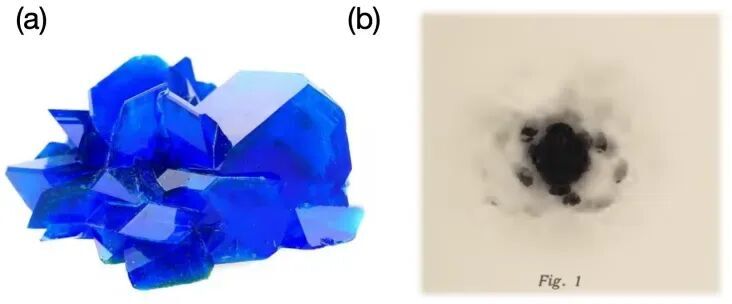
Fig. 1. (a) Copper sulfate pentahydrate, blue crystals precipitated from a hot saturated solution. (b) The first X-ray crystal diffraction pattern, recorded by Laue in 1912[1].
Based on ultralow-temperature magnetocaloric and NMR measurements, together with in-depth theoretical analysis, the team established the complete magnetic field-temperature phase diagram of copper sulfate crystals. The team found that the crystal undergoes a magnetic ordering transition at low temperatures belonging to the Bose-Einstein condensation (BEC) universality class. The transition line terminates at a BEC quantum critical point (QCP) as the magnetic field increases, near which the universal scaling law Tc∝(Bc-B)z/d∝(Bc-B)2/3 holds. Above the BEC QCP lie one-dimensional (1D) and three-dimensional (3D) quantum critical regimes (QCRs): upon cooling, the system undergoes a dimensional crossover from the 1D QCR into the 3D one, and the thermodynamic properties of the two regimes—particularly the magnetocaloric effect—exhibit distinct universal scaling behaviors.
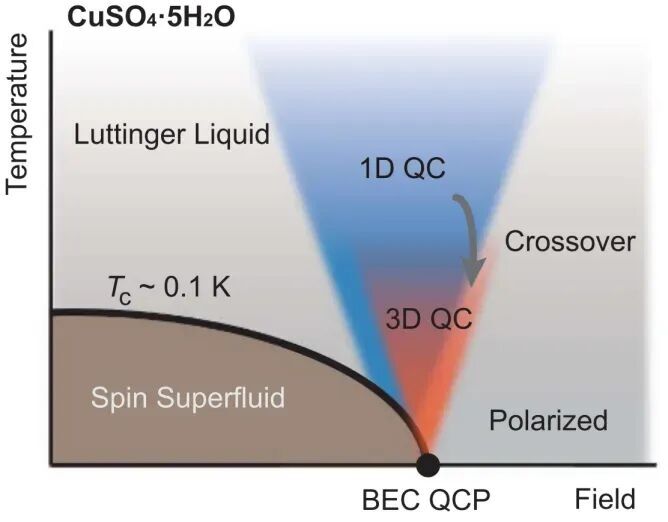
Fig. 2. Magnetic field-temperature phase diagram of copper sulfate crystals.
Through precise measurement and analytical calculation, the collaboration obtained universal magnetocaloric scaling functions in the quantum critical regimes. In the 1D quantum critical regime, the magnetocaloric data collapse perfectly onto the analytical scaling function of the 1D critical Fermi gas (Fig. 3a,b); upon further cooling, as the interchain coupling becomes relevant, the system undergoes a dimensional crossover into the 3D QCR, where the data instead collapse onto the scaling function of the 3D critical Bose gas, in quantitative agreement with the analytical solution of critical Bose field theory. More interestingly, the scaling function depends only on the universality class, not on the microscopic details of the interactions. The same scaling function describes not only copper sulfate crystals but also the spin-chain compound CuPzN and the spin-ladder compound (C5H12N)2CuCl4—despite their completely different crystal structures, interaction strengths, and critical fields, the magnetocaloric behaviors of all three near their QCPs fall onto the same universal scaling function (Fig. 3c,d). The universal magnetocaloric function obtained in this work can describe a broad family of BEC quantum critical magnetic materials.
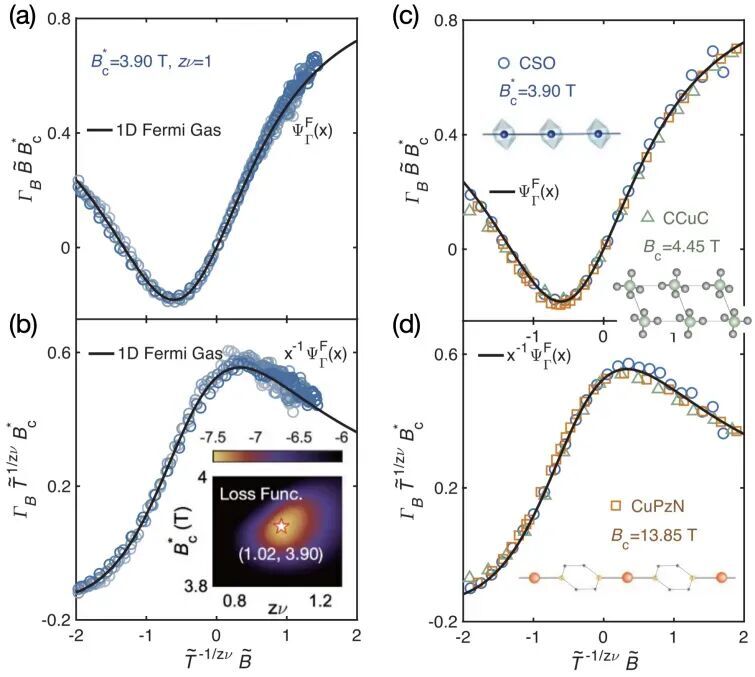
Fig. 3. (a,b) The experimental magnetocaloric data of copper sulfate crystals perfectly match the analytically calculated scaling function of the 1D critical Fermi gas (solid black line). (c,d) The magnetocaloric behaviors of copper sulfate (CSO), the spin-chain compound CuPzN, and the spin-ladder compound (C5H12N)2CuCl4 (CCuC) are all described by the same analytical scaling function.
Copper sulfate crystals also shed light on solid-state refrigeration at ultralow temperatures. Starting from 9 T and 1.8 K, the quantum critical cooling of the Cu-I spin chains first brings the crystal to 68.7 mK near the critical field; as the field is further reduced to zero, the nearly free Cu-II ions “take over” with paramagnetic cooling, eventually reaching 12.8 mK—a temperature that can be maintained below 20 mK for more than seven hours. Benefiting from the strong spin-phonon coupling arising from quantum critical fluctuations, the magnetocaloric relaxation near the QCP is faster and the cooling power higher, opening a new route to helium-3-free solid-state refrigeration at ultralow temperatures, with important implications for frontier areas such as quantum technologies and precision measurement.
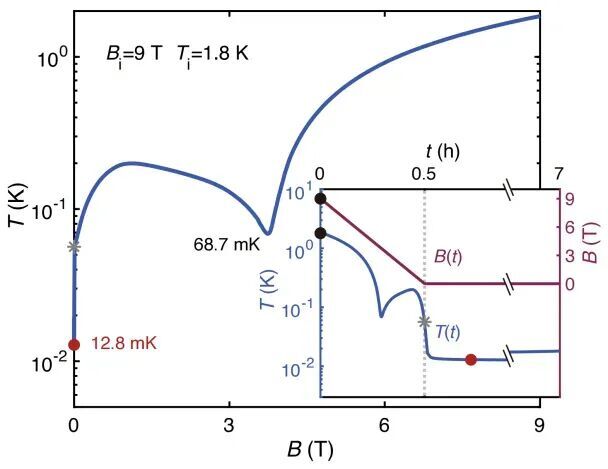
Fig. 4. Adiabatic demagnetization cooling curve of copper sulfate crystals.
Looking back over a century, this ancient an common blue crystal has never ceased to surprise humanity—from witnessing the first X-ray crystal diffraction pattern to inspiring solid-state refrigeration at ultralow temperatures.
Enze Lv, a PhD student at the Institute of Theoretical Physics, is the co-first author of this paper, responsible for theoretical analysis and analytical calculations; Prof. Wei Li and Prof. Gang Su are co-corresponding authors. The other co-first authors are Dr. Junsen Xiang and PhD student Qinxin Shen (Institute of Physics), and the other co-corresponding authors include Prof. Wentao Jin (Beihang University), Prof. Yang Qi (Fudan University), Prof. Rui Zhou, and Prof. Peijie Sun (Institute of Physics). This research is the fruit of close theory-experiment collaboration, funded by the National Natural Science Foundation of China and the CAS Strategic Priority Research Program, with computing support from the HPC cluster of the Institute of Theoretical Physics.

Link:
https://iopscience.iop.org/article/10.1088/1361-6633/ae9cdc
Reference:
[1]. W. Friedrich, P. Knipping, and M. Laue, Sitzungsber. Bayer. Akad. Wiss. Math.-Phys. Kl. 1912, 303 (1912).
Contributor:En-ze Lv