

Research Progress
Efficient Sampling Method for Three-Dimensional Spin Glasses
Spin glasses are a class of complex systems characterized by the coexistence of disorder and frustration. Their internal interactions are partly "cooperative" and partly "competing," giving rise to an enormous number of metastable states separated by high energy barriers. If one imagines all possible microscopic configurations of the system as a landscape, the energy landscape of a spin glass resembles a maze of countless mountains and valleys: once a conventional numerical method falls into one valley, it may take an exceedingly long time to find its way out. How to accurately obtain equilibrium configurations of three-dimensional spin glasses is a long-standing fundamental problem in statistical physics. It bears directly on basic questions such as the glass transition, replica symmetry breaking, and aging dynamics, and it also serves as an important touchstone for numerical methods for complex systems.
Recently, Prof. Pan Zhang of the Institute of Theoretical Physics, Chinese Academy of Sciences, together with his collaborators, proposed the Tensor-Network Markov-Chain Monte Carlo (TNMCMC) method. By introducing tensor-network-guided, large-scale collective updates, the method significantly alleviates critical slowing down in numerical simulations of three-dimensional spin glasses.
Markov-Chain Monte Carlo (MCMC) is the standard tool for studying statistical-mechanical systems. The traditional Metropolis algorithm attempts to flip only one spin at a time. Such local updates are highly effective at high temperatures, but in the low-temperature regime of spin glasses, the system easily becomes trapped in metastable states whose number grows rapidly with system size. As the system grows larger and the temperature drops, the correlation time between successive samples increases dramatically, and equilibration may require prohibitively long simulations.
Cluster updates, which change many spins at once, are an important route to mitigating critical slowing down. However, the random and competing couplings in spin glasses make it difficult for conventional cluster algorithms to correctly capture the intricate spin correlations. On the other hand, directly contracting the tensor network of an entire three-dimensional system incurs an unaffordable computational cost.
The team found a new path between these two extremes: they "slice" the three-dimensional lattice, placing the spins to be updated on two-dimensional layers while temporarily freezing all other spins. Conditioned on the surrounding frozen spins, they use two-dimensional tensor networks to approximately compute the conditional probability of the layer being updated, and generate a new configuration for an entire layer—or two adjacent layers—in a single step. Compared with flipping spins one by one, this update scheme takes "giant strides" across the complex energy landscape, crossing local energy barriers far more efficiently. Since approximate tensor-network contraction inevitably introduces errors, the team applies a Metropolis–Hastings acceptance criterion after the tensor network proposes a candidate configuration, rigorously correcting for the approximation error and ensuring that the sampling results remain exact.
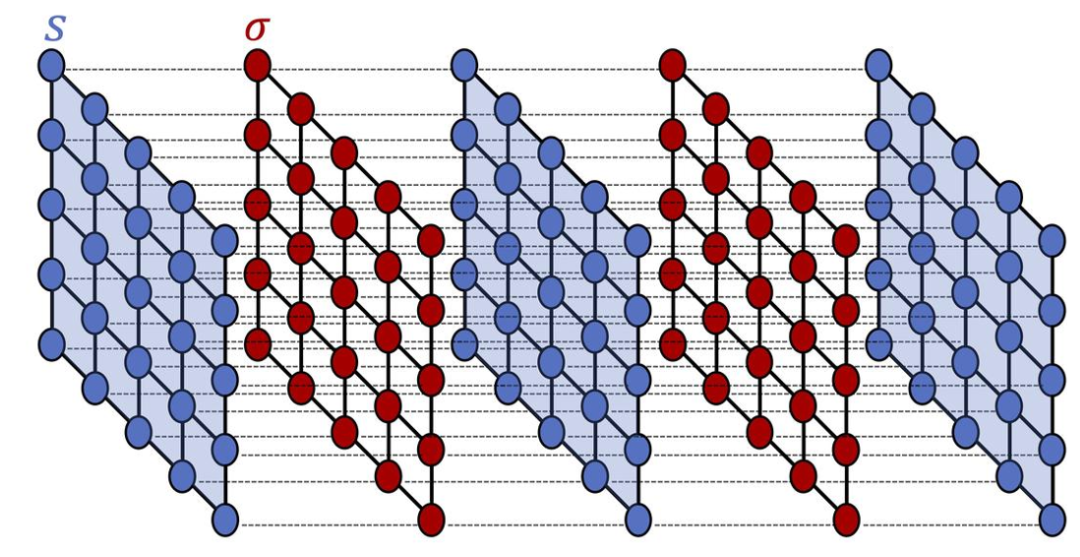
*[Figure] Schematic of the TNMCMC method. The algorithm partitions the three-dimensional lattice into two-dimensional layers to be sampled and temporarily frozen layers, uses tensor networks to generate large-scale candidate configurations, and eliminates the bias from approximate contraction via the Metropolis–Hastings criterion.*
Numerical results on the three-dimensional Edwards–Anderson spin-glass model show that TNMCMC substantially reduces the integrated autocorrelation time of the spin-glass overlap parameter in the low-temperature regime. For a system of linear size 8, TNMCMC achieves orders-of-magnitude savings over the traditional single-spin Metropolis algorithm, in terms of both the number of Monte Carlo steps and the actual wall-clock time required to obtain independent samples; the advantage grows further as the system size increases and the temperature decreases.
TNMCMC can also be combined directly with Parallel Tempering (PT). In comparative experiments with 21 temperature replicas, the combination of TNMCMC and PT achieved the lowest autocorrelation time across the entire tested temperature range. This demonstrates that tensor-network collective updates and inter-replica temperature exchanges complement each other: the former helps the system at each temperature quickly escape local configurations, while the latter further promotes low-temperature equilibration through exchanges between temperatures.
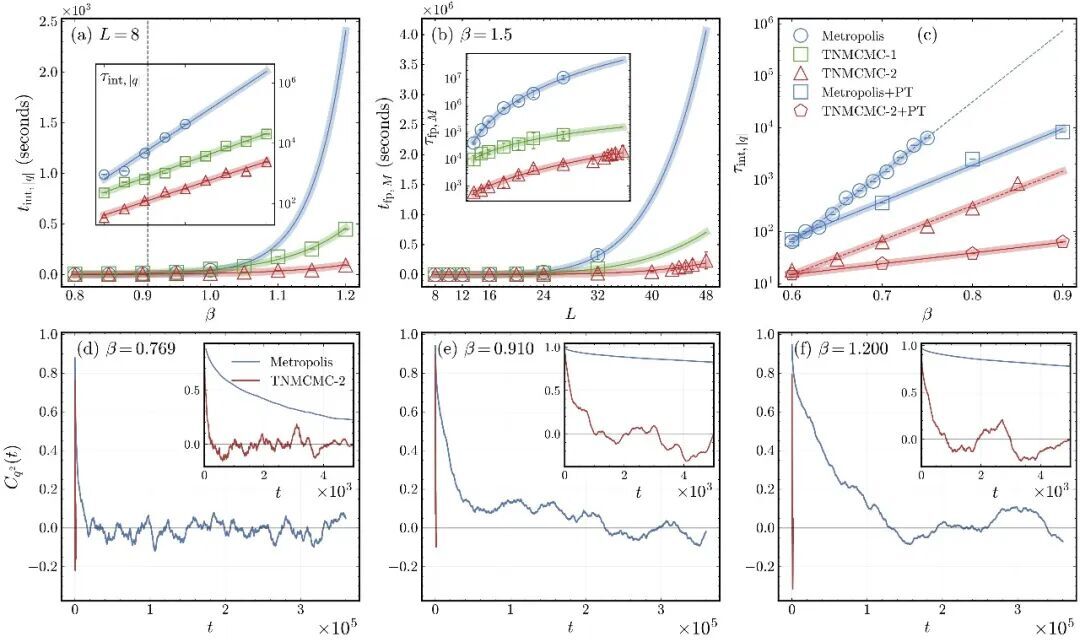
*[Figure] Performance of TNMCMC in the three-dimensional Edwards–Anderson spin-glass model. Compared with the traditional single-spin Metropolis algorithm, TNMCMC significantly shortens both the autocorrelation time and the time needed to escape metastable states; combination with Parallel Tempering further accelerates low-temperature equilibration.*
To test the generality of the method, the team further applied TNMCMC to three-dimensional three-state and four-state Potts models, which exhibit first-order phase transitions. Near a first-order transition, the interface free-energy barrier grows rapidly with system size, and conventional local updates tend to remain trapped in either the ordered or the disordered phase for extremely long times. For three-state Potts models of sizes up to 64×64×64, traditional Metropolis dynamics remains stuck in a single energy valley, whereas TNMCMC repeatedly tunnels back and forth between the ordered and disordered phases and correctly samples the phase-coexistence region. This shows that the method not only mitigates critical slowing down in spin glasses, but also effectively crosses the exponential free-energy barriers of first-order phase transitions.
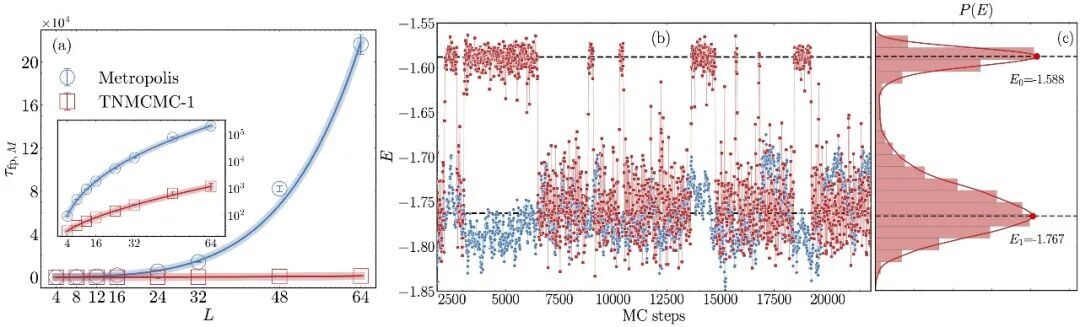
*[Figure] TNMCMC crossing the first-order free-energy barrier of the three-dimensional three-state Potts model. While the traditional Metropolis algorithm remains trapped in a single energy valley, TNMCMC samples back and forth between the ordered and disordered phases.*
The work was published on September 9, 2026 in *Physical Review Letters* (137, 117101) under the title "Tensor-Network Markov-Chain Monte Carlo: Efficient Sampling of Three-Dimensional Spin Glasses." Tao Chen, a PhD student at the University of Science and Technology of China, is the first author of the paper. Assistant Professor Jing Liu of Beijing University of Posts and Telecommunications (formerly a postdoctoral researcher at ITP), Professor Youjin Deng of the University of Science and Technology of China, and Professor Pan Zhang of ITP are the co-corresponding authors. The research was supported by the National Natural Science Foundation of China, the Science and Technology Innovation 2030 Major Project on "Quantum Communication and Quantum Computers," the Strategic Priority Research Program of the Chinese Academy of Sciences, and the Natural Science Foundation of Fujian Province, among others.
Paper link: https://journals.aps.org/prl/abstract/10.1103/96lr-z7tb
Code: https://github.com/Fermichen99/TNMCMC
Contributor: Pan Zhang