

Research Progress
Quantum Criticality and Universal Divergence of the Magnetocaloric Effect in Black Holes
Quantum critical phenomena constitute a central problem in strongly correlated many-body systems, and their universal critical behavior makes quantum criticality a unifying theme across condensed-matter physics, quantum information, quantum gravity, and related fields. Recently, a research team at the Institute of Theoretical Physics, Chinese Academy of Sciences (ITP-CAS), used holographic duality to study magnetic-field-driven quantum phase transitions and uncovered a new ("z=3" ) quantum critical universality class. The study introduced the Grüneisen parameter into black hole physics for the first time and determined its universal divergent scaling law near a holographic quantum critical point (QCP), providing a nonperturbative theoretical framework for understanding metallic quantum criticality beyond the Landau paradigm.
A phase transition occurs when a substance or system changes from one state to another. Water freezing or a magnet losing its magnetization is usually driven by changes in temperature, whereas quantum phase transitions occur at zero temperature and are driven by nonthermal parameters such as magnetic field, pressure, or doping. The transition point of a continuous quantum phase transition is known as a quantum critical point. Condensed-matter physicists Piers Coleman and Andrew J. Schofield once described a quantum critical point as a kind of “black hole” in the material phase diagram [1]: just as a black hole distorts the surrounding spacetime, a zero-temperature quantum critical point can extend its critical fluctuations into the finite-temperature region, forming a V-shaped quantum critical region in the phase diagram. Anomalous phenomena such as unusual specific heat and linear resistivity observed in frustrated magnets, heavy-fermion materials, and high-temperature superconductors are all believed to be closely related to quantum critical points.
Holographic duality gives this analogy a deeper meaning—black holes themselves can serve as theoretical tools for studying strongly coupled quantum criticality. Holographic duality, also known as the AdS/CFT correspondence, maps certain strongly coupled quantum many-body systems into classical gravitational systems in one higher dimension. The quantum system lives at the boundary of the higher-dimensional spacetime, while the extra radial direction in the gravitational description encodes the evolution from high-energy to low-energy physics. Finite-temperature quantum states are described by non-extremal black holes with nonzero surface gravity (Fig. 1). Through this mapping, strongly coupled quantum many-body problems that are difficult to address directly can be recast as more tractable gravitational problems. In this sense, black holes are no longer merely an analogy for quantum critical points—they become a “theoretical laboratory” for exploring quantum critical phenomena in strongly interacting quantum many-body systems.
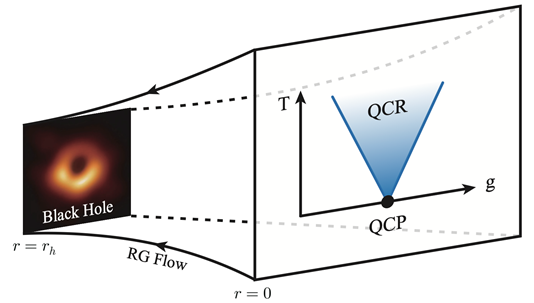
Figure 1. Schematic illustration of the holographic duality. The holographic radial direction encodes the evolution of the quantum system from high to low energies. Finite-temperature physics is described by a black hole, whose near-horizon geometry determines the universal low-energy physics of the quantum critical region.
In this work, the research team investigated magnetic-field-driven quantum phase transitions described by a five-dimensional Einstein-Maxwell-Chern-Simons (EMCS) theory (Fig. 2, left). Based on black hole thermodynamics, they systematically analyzed thermodynamic quantities near the QCP, including entropy, specific heat, magnetization, and magnetic susceptibility, and identified a new "z=3" quantum critical universality class together with its associated critical exponents. The "z=3" critical point is highly robust: when the coupling parameter "k" is varied, the universality class of the quantum critical point remains unchanged. This shows that the result is not an accidental property of an isolated solution or a special parameter choice, but represents a family of QCPs sharing the same low-energy behavior. The researchers termed this the “EMCS cubic universality class.” Furthermore, the critical behavior is characterized not only by its universality class; its complete scaling form—the universal scaling function—is also independent of model details. This illustrates a methodological advantage of holography: without specifying the microscopic Hamiltonian of the many-body system in advance, universal information in the strongly coupled quantum critical region can be systematically extracted directly through black hole physics, providing a gravitational route to exploring quantum critical phenomena that is insensitive to microscopic details.
In particular, for the first time, this work extends the systematic study of the magnetocaloric effect and the Grüneisen parameter to black hole physics and precisely determines their universal divergent scaling near holographic quantum critical points. Just as the gravitational field of a black hole bends light, quantum criticality causes isentropes to bend strongly in the critical region, giving rise to a magnetocaloric effect with universal divergent behavior. As a quantitative measure of this effect, the Grüneisen parameter provides a precise probe for identifying quantum critical points. For a magnetic-field-driven transition, the magnetic Grüneisen parameter characterizes the temperature response of a system when the magnetic field is varied under adiabatic conditions. For second-order quantum phase transitions, scaling theory predicts that it diverges as a power law near the quantum critical point, with the scaling exponent determined by the dynamical critical exponent "z" and the correlation-length critical exponent ν [2]. At the "z=3" holographic QCP, the researchers found a universal power-law divergence, ΓB∝T-1/zν∝T-2/3. In most quantum critical systems, the Grüneisen parameter changes sign as the tuning parameter crosses the critical point, producing a characteristic “peak-dip” structure [3]. In the present system, however, the Grüneisen parameter remains positive and diverges universally in the form of a single peak (Fig. 2, right). This positive-definite divergence without a sign reversal offers distinct advantages for adiabatic demagnetization cooling, from the standpoint of both the underlying physical mechanism and potential applications.
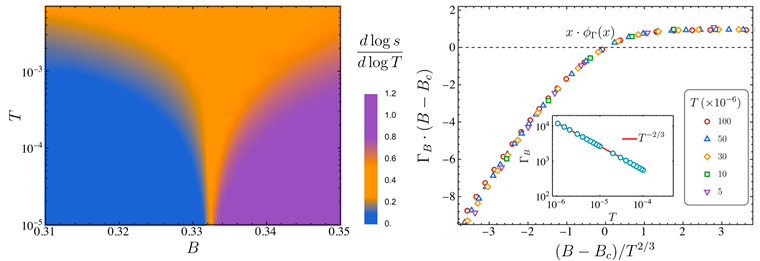
Figure 2. Magnetic-field-driven holographic quantum phase transition. Left: Behavior of entropy density in the T-B phase diagram. Right: the T-2/3 divergence and universal scaling of the magnetic Grüneisen parameter near the quantum critical point.
This result is consistent with experiments on real quantum materials. Recent experiments on the heavy-fermion material CeRh6Ge4 found that its Grüneisen parameter also diverges as T-2/3, pointing to "z=3" critical scaling beyond the Landau framework [4]. This suggests that the holographic QCP may capture the low-energy quantum critical behavior of the related heavy-fermion material. Holography may therefore provide an effective tool for studying strongly coupled quantum systems and may also offer new ideas and computational methods for ultralow-temperature quantum-critical cooling. In addition, the research team found a universal divergence of the Grüneisen parameter in higher-order quantum phase transitions, posing a new challenge for extending the existing theoretical framework.
The results were published in Reports on Progress in Physics under the title “Universally diverging Grüneisen ratio of holographic quantum criticality.” Founded in 1934 by IOP Publishing, Reports on Progress in Physics is one of the most authoritative review journals in physics. Since 2023, the journal has also accepted original research articles, and the present work is one of its original research publications. Dr. Jun-Kun Zhao and PhD student Enze Lv from ITP-CAS are co-first authors. Dr. Jun-Kun Zhao, Prof. Wei Li, and Prof. Li Li are co-corresponding authors. Prof. Wei Li's research focuses primarily on the theory of correlated quantum many-body systems, while Prof. Li Li's research focuses primarily on black holes and gravitational theory. This collaboration represents another example of interdisciplinary collaboration at ITP-CAS.
The work was supported by a project of the National Natural Science Foundation of China, the CAS Strategic Program and other related projects. Numerical calculations were supported by the high-performance computing cluster at ITP-CAS and the Hefei Advanced Computing Center.
References:
[1] P. Coleman and A. J. Schofield, Quantum criticality, Nature 433, 226–229 (2005).
[2] L. Zhu, M. Garst, A. Rosch and Q. Si, Universally Diverging Grüneisen Parameter and the Magnetocaloric Effect Close to Quantum Critical Points, Phys. Rev. Lett. 91, 066404 (2003).
[3] M. Garst and A. Rosch, Sign change of the Grüneisen parameter and magnetocaloric effect near quantum critical points, Phys. Rev. B 72, 205129 (2005).
[4] J. Zhan et al., Critical Fluctuations and Conserved Dynamics in a Strange Ferromagnetic Metal, Phys. Rev. Lett. 135, 266504 (2025); B. Shen et al., Strange-metal behaviour in a pure ferromagnetic Kondo lattice, Nature 579, 51–55 (2020).
Original article:
https://iopscience.iop.org/article/10.1088/1361-6633/ae9b43