

Research Progress
Universal Scaling Laws of Black Hole Supercritical Thermodynamics
Over the past two decades, research on black hole thermodynamics has revealed the similarities between black holes and fluid systems: charged Anti-de Sitter (AdS) black holes exhibit a small black hole–large black hole first-order phase transition analogous to gas–liquid phase transitions. However, a key question has always remained unresolved: in the “supercritical” region above the critical point, what thermodynamic behavior do black holes exhibit? For a long time, very little has been known about this region, and the existing supercritical crossover lines (such as the Widom line and the Frenkel line) are not universal.
Recently, Professor Li Li and Professor Jin Yuliang of the Institute of Theoretical Physics, Chinese Academy of Sciences, collaborated to apply, for the first time, the newly proposed supercritical thermodynamic crossover line L± [1] systematically to black hole thermodynamics. The research team completed numerical verification at six black hole models and seven different critical points, covering various complex systems, including four-dimensional and higher-dimensional Reissner–Nordström–AdS black holes, hairy black holes, Gauss–Bonnet black holes, and Barrow fractal black holes. The results show that the L± line follows a universal scaling law in all of these systems:
δP±∝(T-Tc )β+γ , δρ±∝(T-Tc )β
where β and γ are the general critical exponents of the critical point. The study points out that, unlike single supercritical crossover lines such as the Widom line or the Frenkel line, the L± line divides the supercritical region into three regions, namely the small black hole region, the indistinguishable region, and the large black hole region, and exhibits universal scaling behavior. More importantly, this universal scaling still holds even in complex systems beyond the description of van der Waals fluids, such as hairy black holes with two critical points or Barrow black holes modified by quantum gravity effects.
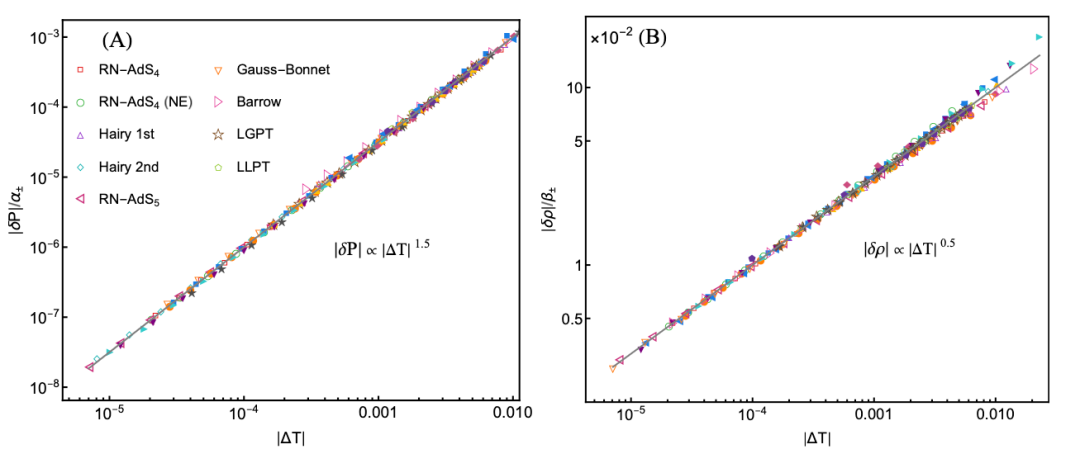
Figure 1 Universal scaling behavior in various complex black hole systems
Another innovation of this study is that, for the first time, it establishes an analogy between black hole thermodynamics and liquid–liquid phase transitions (LLPT) in the non-extended phase space. In the non-extended phase space, the temperature T is treated as an external field (ordering field), while the entropy S serves as the order parameter. The research team found that the phase diagram of such black holes has a coexistence line with negative slope, which is precisely a characteristic hallmark of liquid–liquid phase transitions. Analogous to the fact that liquid–liquid phase transitions are “entropy-driven” rather than “energy-driven”, this provides a new perspective for understanding the thermodynamic behavior of black holes.
This framework applies not only to conventional black hole systems but also provides a new tool for exploring quantum gravity effects. The study shows that, although quantum corrections change the critical parameters of black hole systems, they do not destroy the universal scaling behavior of the L± line. As stated by the researchers: “The universality of black hole supercritical thermodynamics not only deepens our understanding of phase transitions in gravitational systems, but also provides a new theoretical tool for inferring strongly correlated systems such as the QCD phase diagram through the AdS/CFT correspondence.” It is worth noting that black hole supercritical thermodynamics has recently attracted close attention from multiple research groups at home and abroad, and is gradually becoming an emerging hotspot in the field of black hole thermodynamics.
The co-first authors of this work are Wang Shoucheng, Associate Professor at Hunan Institute of Technology (formerly a postdoctoral fellow at ITP), and Li Xinyang, a postdoctoral researcher at Beihang University (a PhD graduate of ITP); Professor Jin Yuliang and Professor Li Li of ITP are the co-corresponding authors. It is worth mentioning that Professor Jin Yuliang’s main research direction is statistical physics and soft matter physics, while Professor Li Li’s main research direction is gravitational theory and black hole physics. This collaboration is a manifestation of cross-directional interdisciplinary collaboration at ITP. This is not the first collaboration between the two. In 2022, they applied the gravitational holographic duality method to study the nonlinear elastic response of granular materials under shear forces, and the related results were published in Science Advances [2]. This research result was published in the international mainstream journal Research (IF = 12.9), a journal jointly founded by the China Association for Science and Technology and the American Association for the Advancement of Science (AAAS) in 2018 and the first collaborative journal of Science since its founding in 1880.
This research was supported by the National Natural Science Foundation of China, the National Key Research and Development Program, the China Postdoctoral Science Foundation, and other projects. The computational work was supported by the high-performance computing cluster of the Institute of Theoretical Physics, Chinese Academy of Sciences, and the Hefei Advanced Computing Center.
References
[1]Xinyang Li and Yuliang Jin, PNAS 121 (18) e2400313121 (2024).
[2]Deng Pan, Teng Ji, Matteo Baggioli, Li Li, Yuliang Jin, Sci.Adv. 8 (2022) 22, abm8028.
Paper link
https://spj.science.org/doi/10.34133/research.1406
Contributor: Yu-liang Jin & Li Li