

Research Progress
Mechanism and realization of loop current order on the kagome lattice
Exploring novel quantum states has been a central theme in modern condensed matter physics. In quantum materials, electrons are not static but are in a state of constant “dance”. In certain strongly correlated systems, electrons can move cooperatively to form circulating microscopic currents and spontaneously break time-reversal symmetry. This phenomenon is known as loop current order (LCO)—a quantum ordered state arising from electrons circulating along specific paths on the lattice. As early as in the study of high-temperature superconductivity in cuprates, LCO was proposed to be closely related to the pseudogap physics [1]. In honeycomb lattice systems, it breaks time-reversal symmetry and can give rise to the quantum anomalous Hall effect, making it an important model for investigating topological quantum states of matter [2]. Understanding loop current order is therefore of great significance for revealing the physical mechanisms of high-temperature superconductivity and topological states. Although scientists have searched for this exotic order in various systems including cuprates and honeycomb materials for many years, whether LCO can exist in real quantum materials and theoretical model has long remained controversial both experimentally and theoretically. In recent years, kagome metals have exhibited signatures of time-reversal symmetry breaking in the charge density wave phase [3,4], providing key clues for revisiting this issue. As early as 2021, phenomenological studies suggested that the kagome metal AV₃Sb₅ could realize a unique loop current order, i.e., the chiral flux phase [5]. Nevertheless, the physical realization and microscopic mechanism of LCO have remained highly challenging.
Recently, Prof. Xianxin Wu and Prof. Sen Zhou from the Institute of Theoretical Physics, Chinese Academy of Sciences, together with Prof. Jiangping Hu from Institute of Physics, Chinese Academy of Sciences and Prof. Ziqiang Wang from Boston College, conducted a systematic study on this problem in the kagome lattice. The team found that near the sublattice-pure (p-type) van Hove filling, the unique geometry and electronic structure of the kagome lattice give rise to three sublattice-polarized van Hove singularities (Fig. 1). Systematic analysis shows that electron scattering with finite momentum (M point) connecting different van Hove singularities significantly enhances bond charge fluctuations, a behavior distinctly different from the strong on-site charge fluctuations in square, triangular, and honeycomb lattices. Furthermore, combined with the geometric frustration inherent to the lattice, the team points out that the nearest-neighbor bonds are dominated by real charge fluctuations, whereas the next-nearest-neighbor bonds exhibit prominent imaginary charge (loop current) fluctuations (Fig. 1). These results indicate that the kagome lattice possesses intrinsic strong loop current fluctuations. Taking the effective spinless interacting kagome lattice model near the sublattice-pure van Hove filling as a starting point, the research team systematically investigated the low-energy instabilities under nearest-neighbor and next-nearest-neighbor nonlocal Coulomb interactions using the unbiased functional renormalization group many-body method. The results show that when the next-nearest-neighbor Coulomb repulsion is enhanced, the imaginary bond order correlation fluctuations are significantly amplified. Under the synergistic mechanism of sublattice interference and kagome geometric frustration, common competing orders such as on-site charge density wave are effectively suppressed, and a 2×2 electronic loop current order ground state characterized by time-reversal symmetry breaking is ultimately stabilized (Fig. 2). In addition, the team also obtained competing phases such as nematic order, bond charge order, and f-wave superconductivity, and elucidated their physical origins and evolution relations. Moreover, in the model with spin degrees of freedom, they found that loop current order fluctuations can significantly enhance chiral d+id superconducting pairing [6]. These results provide a new perspective for understanding the rich variety of correlated ground states in kagome metal materials.
This work is the first to realize a 2×2 LCO many-body ground state on the kagome lattice using an unbiased many-body computational method and clearly reveals its microscopic mechanism: sublattice interference effect and the unique geometry of the kagome lattice synergistically enhance bond charge order fluctuations, which under the drive of nonlocal interactions promote LCO to become the ground state of the system. This conclusion advances LCO from a phenomenological hypothesis to a genuine quantum state of matter that can be realized in theoretical models, providing solid theoretical support for understanding the time-reversal symmetry breaking phenomena in kagome metals. Furthermore, the study proposes a universal mechanism that promotes the formation of LCO through the synergy of sublattice interference effect and lattice geometry, offering important insights for exploring unconventional charge orders and many-body correlated states in a broader range of quantum materials.
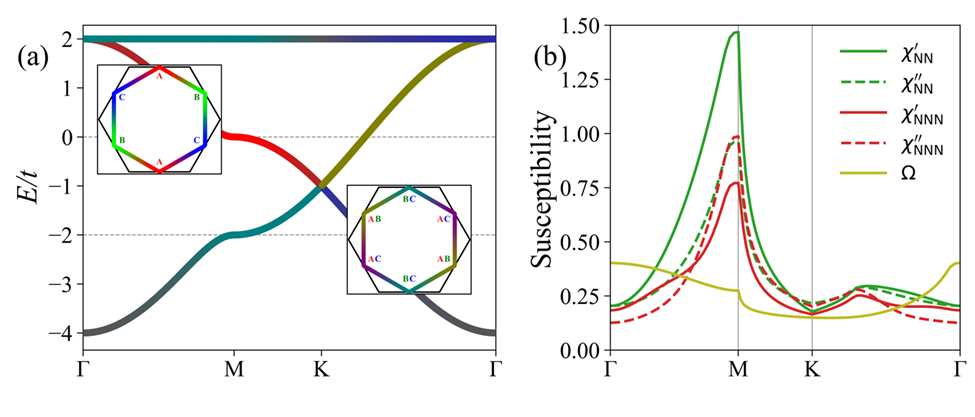
Fig.1. Band structure (a) and charge polarizability (b) of the kagome lattice. At the sublattice-pure van Hove filling, the sublattice interference effect suppresses the local charge fluctuations at the M point and enhances the real bond charge order (solid lines) fluctuations on the nearest-neighbor (NN) bonds and the imaginary bond charge order (dashed lines) fluctuations on the next-nearest-neighbor (NNN) bonds, respectively.
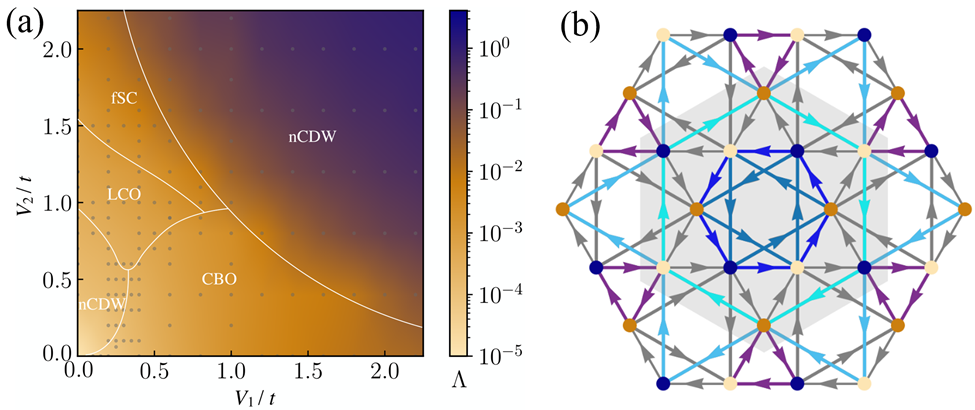
Figure 2. (a) Phase diagram of the spinless interacting kagome model at the pure sublattice-type van Hove filling. (b) real-space current pattern of a representative 3Q loop current order on the nearest-neighbor and next-nearest-neighbor bonds.
Paper link:
https://academic.oup.com/nsr/article/12/11/nwaf414/8267852
https://doi.org/10.1103/5vyy-rj6v
References:
[1] C. M. Varma, Non-Fermi-liquid states and pairing instability of a general model of copper oxide metals, Phys. Rev. B 55, 14554 (1997).
[2] F. D. M. Haldane, Model for a quantum Hall effect without Landau levels: condensed-matter realization of the parity anomaly, Phys. Rev. Lett. 61, 2015 (1988).
[3] J. Yin et al., Unconventional chiral charge order in kagome superconductor KV3Sb5, Nature materials 20 (10), 1353-1357 (2021).
[4] C. Mielke III et al., Time-reversal symmetry-breaking charge order in a kagome superconductor, Nature 602, 245 (2022) (2023).
[5] X. Feng, K. Jiang, Z. Wang, J. Hu, Chiral flux phase in the Kagome superconductor AV3Sb5, Sci. Bull. 66(14), 1384-1388 (2021).
[6] Q. Li, G. Pan, X. Zhang, S. Nakatsuji, W. Jiang, X. Xu and X. Wu, Loop-Current Fluctuations Mediated Chiral d-Wave Pairing in Kagome Lattice, Chin. Phys. Lett. 42 057302 (2025).
Contributor: Xian-xin Wu