

Research Progress
“Liquid-gas transition” in antiferromagnet: Emergent critical endpoint and supercritical phenomena in Nd3BWO9
Frustrated magnets exhibit a rich landscape of spin states and phase transitions, out of which emerge elegant universal laws and novel magneto-thermal effects. Recently, a team led by Prof. Wei Li at the Institute of Theoretical Physics, together with collaborators, extended the liquid-gas analogy to frustrated antiferromagnets through a study of the Ising spiral antiferromagnet Nd₃BWO₉. They revealed emergent critical points and supercritical behavior, established universal magnetocaloric scaling relations, and opened a new route to ultralow-temperature solid-state refrigeration. The mechanism is universal and applies broadly to Ising-anisotropic systems with metamagnetic transitions such as spin ice. This work was published in Physical Review Letters and selected as a PRL Editors' Suggestion.
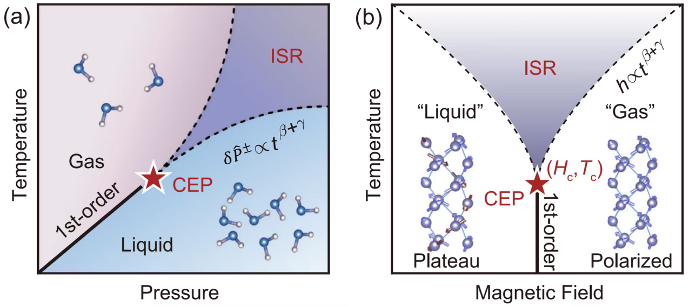
Fig. 1. (Left) Liquid-gas phase diagram of water. (Right) Magnetic field–temperature phase diagram of the spiral Ising antiferromagnet. The red pentagram marks the critical endpoint (CEP). Above the CEP lies the extended Ising supercritical regime (ISR); dashed lines indicate supercritical crossover boundaries.
Introduction---The liquid-gas transition line of water does not extend forever: it terminates at a critical point. Beyond this point, liquid and gas become indistinguishable, and the system enters the supercritical state. The critical point is singular and features an emergent Z₂ symmetry; its critical behavior falls into the same universality class as the three-dimensional Ising ferromagnet. This deep correspondence is not confined to classical fluids. Analogous critical points and supercritical phenomena have also been found in organic conductors, doped Mott insulators, and even in the phase diagram of quantum chromodynamics.
In magnetic systems, ferromagnets present a similar picture in the magnetic field–temperature phase diagram: the magnetic field plays the role of pressure in a liquid-gas transition, coupling directly to the ferromagnetic order parameter, so that the first-order line also terminates at a critical point in the field-temperature plane (see Fig. 1). This naturally raises a question: do analogous critical points exist in antiferromagnets? And what novel observable effects might they produce? The answer is far from obvious. An antiferromagnet corresponds to nearest-neighbor repulsion in the lattice-gas picture; rather than forming a liquid-gas coexistence region, it tends toward solid-like order. Moreover, the magnetic field does not couple directly to the antiferromagnetic order parameter and thus does not drive a first-order transition, making the analogy seem difficult to establish.
A Surprising Turn: Emergent Critical Points in Spiral Ising Antiferromagnets---Recently, experimentalists synthesized a new three-dimensional rare-earth frustrated magnet, Nd₃BWO₉ (NBWO), which features a stacked-kagome structure. The Nd³⁺ ions form Kramers doublets, giving S=1/2 pseudospins. Similar to spin ice, NBWO has strong Ising anisotropy, with the Ising axes winding spirally along the c direction. Through detailed specific heat and susceptibility measurements, the research team established its magnetic field–temperature phase diagram (Fig. 2), identifying a field-driven metamagnetic transition line accompanied by jumps of the magnetic moment.
Here, the magnetic field couples to the order parameter (magnetic moment) and drives the metamagnetic transition. Analogous to the liquid-gas transition, this first-order metamagnetic line terminates at a critical endpoint (CEP), located at μ0Hc≈1.04 T, and Tc≈0.30 K. Above the CEP, the system enters the Ising supercritical regime (ISR), whose boundaries can be determined from specific heat, magnetic susceptibility, and magnetocaloric effect measurements. We find that the boundary follows a supercritical scaling law, h ∝tβ+γ, with β+γ≈1.563 belonging to the three-dimensional Ising universality class. Moreover, the susceptibility data collapse perfectly onto a universal function ϕχ(x), in excellent agreement with Monte Carlo calculations for the 3D Ising model. This provides strong support for the emergent Ising critical point and the associated supercritical scaling laws.
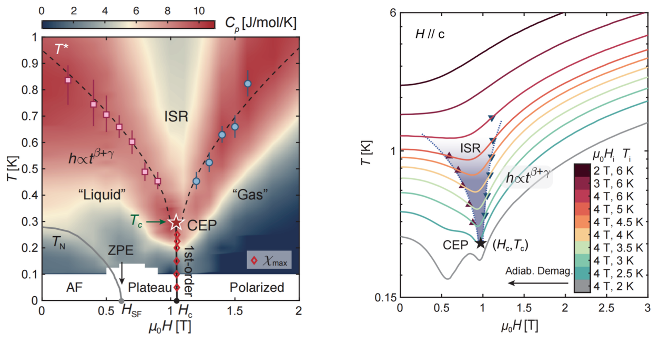
Fig. 2. (Left) Field-temperature phase diagram of Nd₃BWO₉. The red pentagram marks the critical endpoint (CEP). The fan-shaped region above the CEP is the Ising supercritical regime (ISR). For H<Hc, the system is in a plateau phase, corresponding to the "liquid" phase; for H>Hc, it enters a partially polarized state, corresponding to the "gas" phase. At the field HSF, low-energy topological excitations give rise to a proximate zero-point entropy (ZPE). (Right) Adiabatic demagnetization measurements on Nd₃BWO₉. The ISR exhibits a universal supercritical magnetocaloric effect.
Supercritical Magnetocaloric Effect and Topological-Excitation Cooling---The emergent critical point and its supercritical regime host strongly fluctuating spin states that are highly sensitive to external fields, giving rise to a significant magnetocaloric effect. The team performed adiabatic demagnetization measurements and found that, above the critical point, the magnetic Grüneisen parameter diverges and satisfies a universal supercritical scaling law,ΓH ∝1/tβ+γ-1. Moreover, near the spin-flip field HSF, nearly energy-free topological domain-wall excitations appear in the spiral chains of the magnet. Under ideal conditions, these would produce macroscopic degeneracy and zero-point entropy. In a real material, residual interactions lift this degeneracy at sufficiently low temperatures, yet a substantial proximate zero-point entropy remains. The team thus realized a "self-cascading refrigeration" in NBWO that combines the supercritical magnetocaloric effect (at μ0Hc≈1.04T) with the topological-excitation magnetocaloric effect (at μ0HSF≈0.65T). Starting from 4T and 2K, the temperature drops sharply first due to supercritical fluctuations and then due to the proliferation of topological domain-wall defects, ultimately reaching an ultralow temperature of 195 mK.
Broader Insights: A New Refrigeration Mechanism in Frustrated Magnets---For conventional ferromagnetic refrigerants, the refrigeration temperature (≈ Curie temperature) depends on the ion density, and achieving ultralow temperatures often requires sacrificing the ion density. In recent years, driven by the pursuit of spin liquids, researchers have synthesized and studied a wealth of new frustrated magnetic materials, opening fresh possibilities for magnetic refrigeration. NBWO has a relatively high magnetic ion density, yet magnetic frustration suppresses the critical temperature and generates topological excitations, enabling simultaneously a refrigeration temperature as low as 195 mK and a saturation magnetic entropy density of 162 mJ·K⁻¹·cm⁻³—--far exceeding that of the conventional hydrated paramagnetic salt CMN (15.8 mJ·K⁻¹·cm⁻³). Against the backdrop of a global helium-3 shortage, the supercritical magnetocaloric effect and topological-excitation cooling exhibited by NBWO provide a universal new mechanism for solid-state refrigeration, and similar behavior is expected to be observed in strongly Ising-anisotropic systems such as spin ice.
The co-first authors of this work are Xinyang Liu (School of Physics, Beihang University, and Peng Huanwu Collaborative Center for Research and Education), Enze Lv (Institute of Theoretical Physics), Xueling Cui (School of Physics, Beihang University), and Han Ge (Department of Physics, Southern University of Science and Technology). The co-corresponding authors are Professor Kan Zhao (School of Physics, Beihang University), Associate Professor Junsen Xiang (Institute of Physics), Professor Peijie Sun (Institute of Physics), and Professor Wei Li (Institute of Theoretical Physics). Collaborators also include Fangyuan Song and Professor Zhaoming Tian from Huazhong University of Science and Technology, and Professor Gang Su from the Institute of Theoretical Physics. The research was supported by the National Key Projects for Research and Development of China, the National Natural Science Foundation of China, and other programs; the experimental part was also supported. The results were published in Physical Review Letters on June 17 under the title “Ising Supercriticality and Universal Magnetocalorics in Spiral Antiferromagnet Nd₃BWO₉,” and selected as a PRL Editors’ Suggestion.
Paper link: https://journals.aps.org/prl/abstract/10.1103/nqcw-pz8v
Contributor:Wei Li 's Group