

Research Progress
Probing the Spacetime Ripples: Rigorous Observables of Higher-Order Gravitational Waves
In 1936, Albert Einstein and Nathan Rosen submitted a manuscript with a striking title, "Do Gravitational Waves Exist?", to Physical Review (the predecessor of modern APS journals like PRL). Their answer was negative. Einstein wrote in a letter to Max Born: "Gravitational waves do not exist, though they had been regarded as certain in the first approximation." Upon review, the referee H.P. Robertson, through a rigorous evaluation, pointed out that the divergence Einstein obtained while solving the equations was merely a coordinate singularity caused by an inappropriate choice of the coordinate system [1]. This ten-page review report prevented Einstein from making another "biggest blunder" regarding gravitational waves. However, it left him uncomfortable with the strict peer-review system of Physical Review, and he never submitted to this journal again for the rest of his life.
Since then, generations of physicists have never ceased their steps in probing the spacetime ripples. Eighty years later, the LIGO detectors successfully captured gravitational wave signals from a binary black hole merger, which not only observationally confirmed the prediction of general relativity but also marked the official birth of gravitational-wave astronomy as the cutting-edge frontier of cosmic exploration. As observational precision transitions from "detecting" to "pinpointing," a challenge far more complex than the one Einstein faced has surfaced: the gauge dependence problem of second-order gravitational waves. In general relativity, we possess the freedom to choose the coordinates describing the universe. At the linear order, the physical meaning of gravitational waves is well-defined and independent of coordinate choices. However, at the more intricate non-linear level, gravitational waves couple with other perturbations, making theoretical predictions variant under different coordinate systems. Consequently, second-order gravitational waves calculated by physicists in different gauges (such as the Newtonian gauge, synchronous gauge, and comoving gauge) differ drastically [2]. Due to the lack of a unified "physical observable" as a benchmark, the academic community has long debated over "which result represents the real physical existence" [3]. This ambiguity directly hinders core scientific goals, such as precisely pinning down primordial black hole dark matter using observational signals [4].
To resolve this contemporary controversy, Prof. Shi Pi’s group at the Institute of Theoretical Physics, Chinese Academy of Sciences (ITP-CAS), along with their collaborators, took a novel approach. Instead of entangling themselves in the pros and cons of abstract mathematical coordinates, they focused on the actual observational effects on detectors when a gravitational wave passes by. This study achieves a paradigm shift from "coordinate selection" to "physical observables." The research team adopted a rigorous "geodesic clock" observational scheme: consider two free-falling observers in an expanding universe. They measure the time delay by emitting and receiving electromagnetic signals (laser signals in interferometers or radio signals from pulsars) traveling along null geodesics. Since time delay and redshift are genuine physical observables, they must be physically independent of any gauge choice. This synchronous observation scheme is formally equivalent to the proper time measured by a Fermi-normal observer. The constant-time hypersurfaces defined through these geodesics are equivalent to the constant-proper-time hypersurfaces in the Fermi-normal coordinate system, aligning perfectly with the construction of "cosmic clocks" used to describe large-scale structure observables in cosmology [5].
Based on this physical picture, the research team solved the geodesic motion of the observers and rigorously calculated the second-order timelike geodesic integrals considering perturbation boundary conditions. In handling the tangled and intricate second-order perturbation terms, they naturally decomposed the time delay into a component induced by gravitational wave propagation and boundary terms originating from the observers' motion and initial conditions, strictly distinguishing the latter from the former. Following rigorous mathematical derivations, the study reveals a clear conclusion: within the second-order time delay measured by the detector, the signal genuinely caused by gravitational wave propagation is entirely determined by the second-order transverse-traceless metric perturbations in the Newtonian gauge. The measurement process itself acts like a “gauge filter”, automatically weeding out non-physical components associated with coordinate choices.
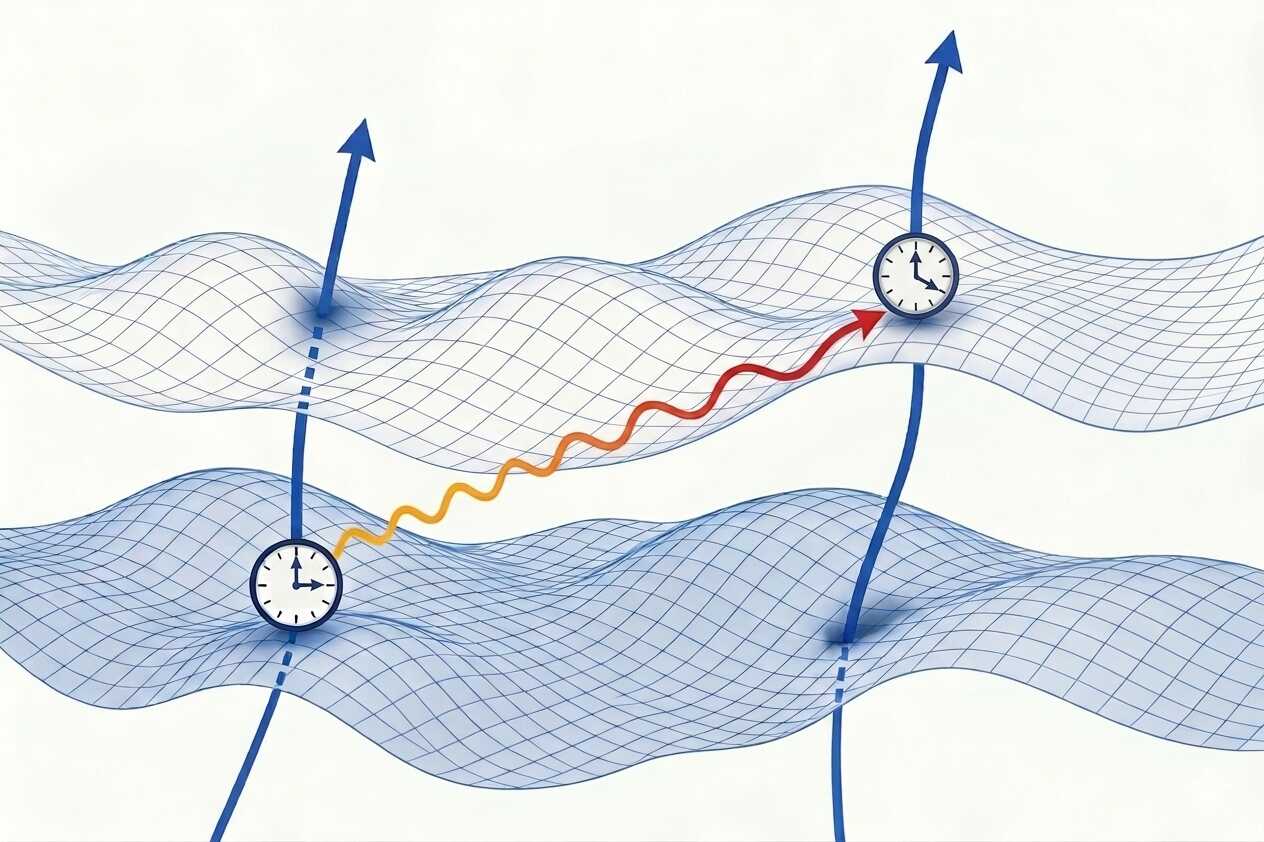
Figure 1: Schematic diagram of electromagnetic signals transmitted between geodesic clocks under a secondary stochastic gravitational wave background.
This discovery provides a solid theoretical foundation and a convenient computational framework for the observational predictions of secondary gravitational waves. Whether for unravelling the physical nature of the nanohertz stochastic gravitational wave background using pulsar timing arrays (PTAs), or for detecting and constraining primordial black hole dark matter through space-borne gravitational wave interferometers like Taiji, TianQin, and LISA, this study offers vital theoretical support for accurately capturing secondary gravitational wave signals. It not only observationally clarifies the long-standing gauge-selection dispute over secondary gravitational waves, but also explicitly maps the correspondence between higher-order metric perturbations and observable signals, laying a critical cornerstone for gravitational-wave cosmology to transition from the "era of discovery" to the "era of precision observation." From Einstein’s confusion over coordinate singularities in 1936 to the strict establishment of higher-order gravitational wave observables today, this nearly century-long journey of probing spacetime has finally arrived at a clear answer.
The related achievements, titled "Observable Gravitational Wave Strain at Second Order", have been published in the latest issue of Physical Review Letters (PRL) and selected as an Editors' Suggestion. Dr. Guillem Domènech from Leibniz University Hannover, Prof. Shi Pi from the Institute of Theoretical Physics, CAS, and Ph.D. student Ao Wang are the joint corresponding authors of this paper. According to the international convention in high-energy and theoretical physics, the authors are listed alphabetically by surname, and all three authors are co-first authors of this work with equal contributions. This research was supported by the Ministry of Science and Technology's National Key R&D Program, the National Natural Science Foundation of China (NSFC), the German Research Foundation's (DFG) Emmy Noether Programme, and the CAS International Visiting Student Program, among other funding support.
Paper Link: https://doi.org/10.1103/pwbs-xwrh
References
[1] J.X. Liu, A clash between Einstein and the peer-review system [J]. Physics, 2005, 34(07): 487-490.
[2] Gauge dependence of gravitational waves generated from scalar perturbations, Jai-Chan Hwang, Donghui Jeong, Hyerim Noh, Astrophys.J. 842 (2017) 1, 46.
[3] Approximate gauge independence of the induced gravitational wave spectrum, Guillem Domènech, Misao Sasaki. Phys.Rev.D 103 (2021) 6, 063531 • e-Print: 2012.14016 [gr-qc].
[4] Gravitational Waves Induced by non-Gaussian Scalar Perturbations, Rong-Gen Cai, Shi Pi, Misao Sasaki. Phys.Rev.Lett. 122 (2019) 20, 201101.
[5] Cosmic Clocks, Donghui Jeong and Fabian Schmidt. Phys. Rev. D 89 (2017) 4, 043519.
Contributor: Shi Pi