

Research Progress
A New Mechanism for Magnon Damping in Metallic Ferromagnets
Recently, a collaboration between Prof. Wei Li's group at the Institute of Theoretical Physics, Chinese Academy of Sciences, and the groups of Prof. Jinsheng Wen and Prof. Jian-Xin Li at the School of Physics, Nanjing University, reported important progress in the study of spin dynamics in metallic ferromagnets. The team revealed, for the first time, a new mechanism of magnon damping driven by Kondo coupling. This finding extends the scope of Kondo physics from its traditional focus on transport anomalies of itinerant electrons, such as anomalous resistivity, to the dynamical effects of collective spin excitations of local moments. The related work, titled “Magnon Damping as a Probe of Kondo Coupling in Magnetically Ordered Systems,” was published in Nature Communications on March 6, 2026 [Nat. Commun. 17, 3557 (2026)].
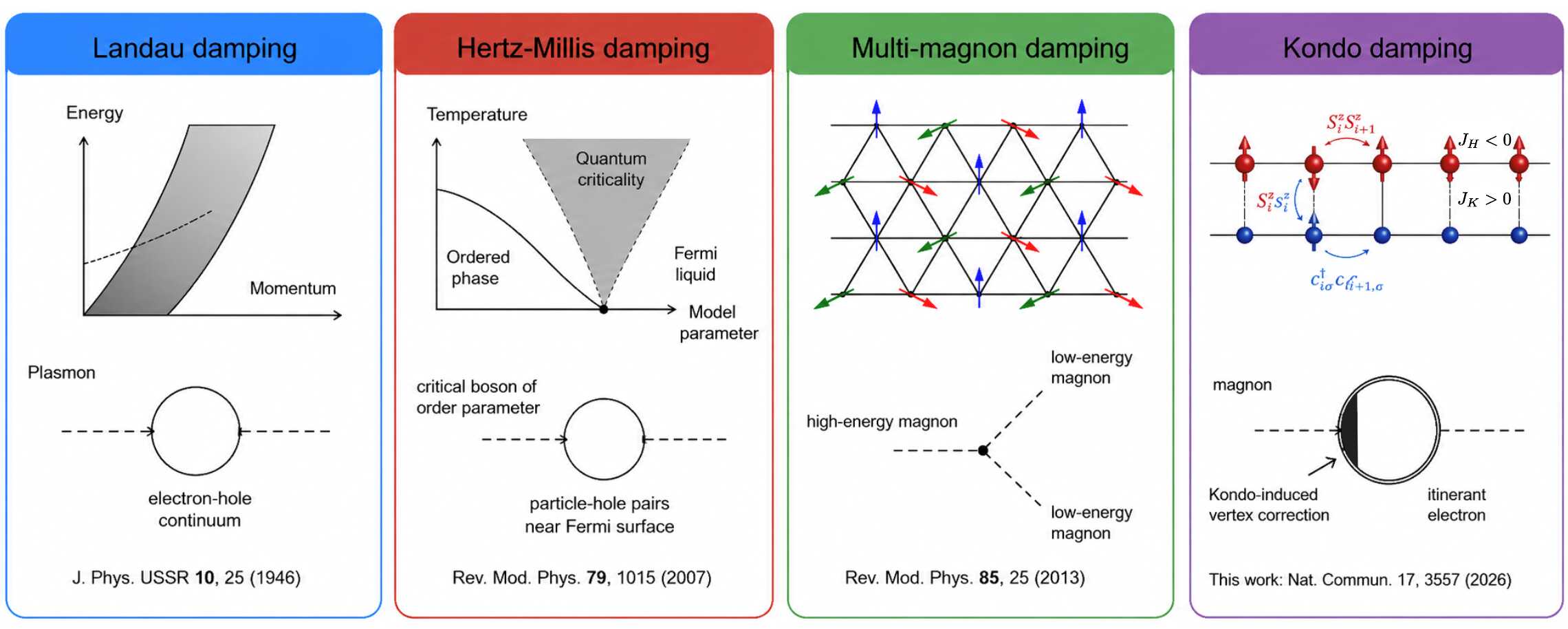
Figure 1. Several mechanisms of magnon damping. From left to right: Landau damping, Hertz-Millis damping, multi-magnon damping, and the Kondo damping mechanism proposed in this work.
Magnon dynamics: from conventional damping mechanisms to Kondo damping
In magnetic systems, magnons are affected by interactions and by their environment, leading to damping. This damping can be characterized by a damping coefficient, whose inverse corresponds to the finite magnon lifetime. Understanding the microscopic mechanisms of magnon damping is a central issue in spin dynamics. Common mechanisms include Landau damping, in which a collective excitation transfers energy by decaying into an electron-hole continuum; Hertz-Millis damping, which arises from the coupling between spin fluctuations and the Fermi surface in a quantum-critical regime and introduces dissipative dynamical damping; and multi-magnon damping in frustrated magnets, where anharmonic interactions allow a single high-energy magnon to spontaneously decay into two or more lower-energy magnons. Beyond these mechanisms, whether qualitatively different mechanisms of magnon damping exist in condensed-matter magnetic systems is an important and intriguing fundamental question. Through close collaboration between theory and experiment, the present work identifies a previously unrecognized mechanism: it is driven by Kondo coupling between local moments and itinerant electrons in a Kondo-lattice system and produces damping of the collective spin excitations of local moments.
The “Kondo effect” in magnon spectra
In the 1950s, dilute magnetic alloys, such as copper containing a small amount of magnetic iron impurities, were found to exhibit an anomalous minimum in resistivity at low temperature: upon further cooling, the resistivity increases logarithmically. This phenomenon was subsequently studied systematically in heavy-fermion systems containing elements such as Ce, Yb, and U. The experimental part of the present work was carried out on the van der Waals ferromagnetic metal Fe₃₋ₓGeTe₂ (FGT), a metallic ferromagnet with a two-dimensional van der Waals structure and a high Curie temperature. By measuring the low-energy magnon spectrum using inelastic neutron scattering and analyzing the experimental data with a damped harmonic oscillator model, the researchers found that the magnon damping exhibits a pronounced nonmonotonic temperature dependence, with a minimum at intermediate temperatures and a logarithmic divergence at low temperatures.
Theoretical analysis shows that, owing to the Kondo effect, the spin-flip scattering vertex between electrons and magnons is renormalized, thereby introducing logarithmic corrections into the imaginary part of the magnon self-energy. This effect makes the magnon damping nonmonotonic as a function of temperature: it has a minimum in the intermediate-temperature regime and shows logarithmic enhancement at low temperatures. This behavior is analogous to the anomalous logarithmic increase of resistivity at low temperature in the Kondo effect; here, however, the effect appears in the dynamics of collective excitations of local moments, namely as a “Kondo effect” in the magnon spectrum.
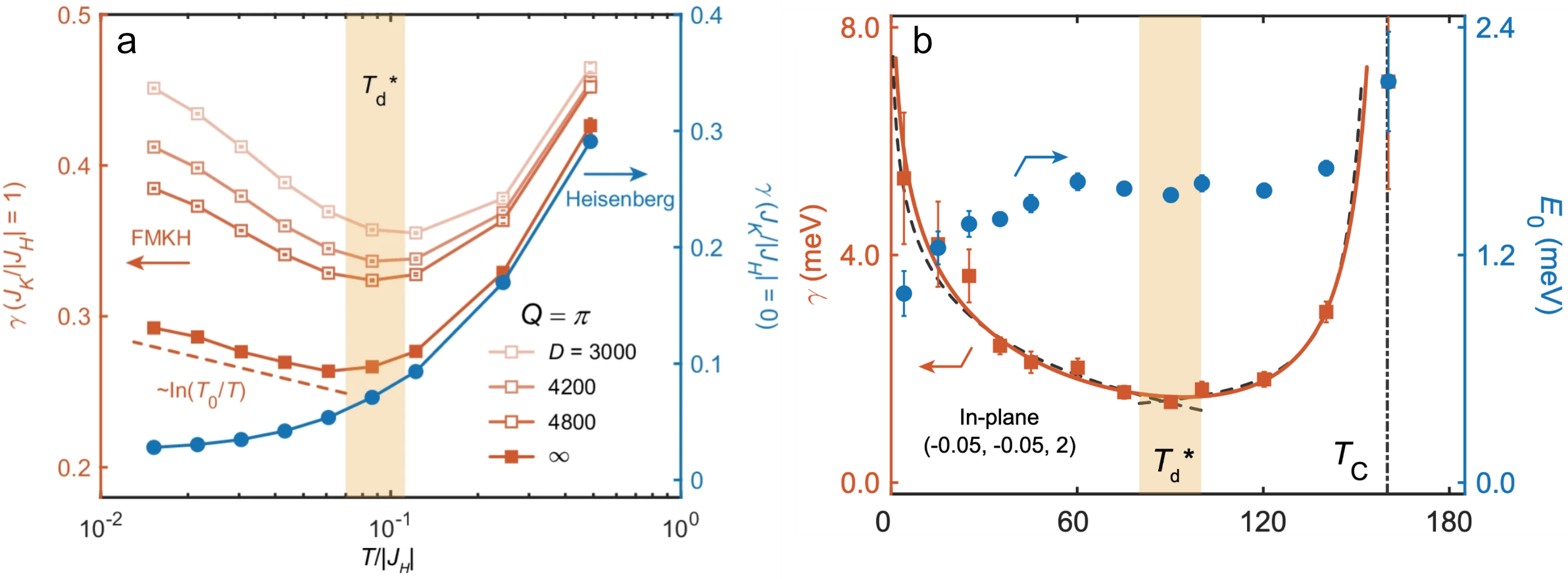
Figure 2. Temperature evolution of magnon damping. (a) Finite-temperature tensor-network results. (b) Experimental data.
Dual character of 3d electrons and the Kondo-Heisenberg lattice model
In FGT, magnetism displays the dual character of coexisting local moments and itinerant electrons: part of the Fe 3d electrons tends to localize, forming local moments and establishing ferromagnetic order, while another part remains itinerant and dominates the metallic transport. Based on this feature, the team constructed a ferromagnetic Kondo-Heisenberg lattice model to account simultaneously for the interaction between itinerant electrons and local spins:

Here, c,c+denotes the creation/annihilation operator for itinerant conduction electrons, and Sₙ (sₙ) denotes the spin operator of the local moment (electron), respectively. Using tensor-network methods, the collaborators performed high-precision calculations of the dynamical properties and reproduced the logarithmic temperature dependence observed experimentally (see Fig. 2a). Further perturbative analysis indicates that the damping minimum observed in experiment (Fig. 2b) originates from the competition between vertex renormalization induced by Kondo coupling, which gives logarithmic corrections, and thermal-fluctuation contributions, which follow a power-law behavior.
The study further demonstrates that Kondo damping of magnons can serve as an effective spectroscopic probe of Kondo coupling in metallic quantum magnets. It extends Kondo physics from single-impurity or localized-spin systems to the realm of collective spin excitations, providing a new perspective for investigating electron-spin coupling in magnetically ordered metals.
Assistant Professor Song Bao from Prof. Jinsheng Wen's group at the School of Physics, Nanjing University; Yuan Gao, a jointly trained doctoral student at the Institute of Theoretical Physics, Chinese Academy of Sciences; and Dr. Junsen Wang, formerly a postdoctoral researcher and currently a special associate researcher at the High Magnetic Field Laboratory, Hefei Institutes of Physical Science, are the co-first authors of the paper. Prof. Wei Li, Prof. Jian-Xin Li, and Prof. Jinsheng Wen are the co-corresponding authors. The authors acknowledge fruitful discussions with Prof. Tao Shi at the Institute of Theoretical Physics. This work was supported by the National Key Research and Development Program of China, the National Natural Science Foundation of China, and other funding sources. The theoretical calculations were performed on the Advanced Computing Platform of the Institute of Theoretical Physics, Chinese Academy of Sciences.
Paper link: https://doi.org/10.1038/s41467-026-70241-5
Contributor: Wei Li