

Research Progress
Verifying Parisi’s theory in three dimensions: Full replica symmetry breaking in granular matter
In 2021, Italian physicist Giorgio Parisi was awarded the Nobel Prize in Physics for his pioneering contributions to the theory of disordered systems. He established the full replica symmetry breaking(fullRSB) theory to describe the thermodynamic and statistical physics behavior of disordered materials such as spin glasses. However, the rigorous validity of this theory had previously only been proven mathematically in infinite-dimensional spaces. In the real three-dimensional world, does the fullRSB theory still hold?
Recently, a collaborative team from the Institute of Theoretical Physics - Chinese Academy of Sciences (ITP-CAS) and Peking University published a study in Physical Review Letters. They systematically mapped the energy landscape—including both energy minima and saddle points—of a three-dimensional granular system. They found that the landscape exhibits ultrametricity and self-similarity, fully consistent with the predictions of fullRSB theory. This result demonstrates that this profound theory is also applicable to real disordered materials, highlighting its universality.
The energy landscape is a high-dimensional surface describing how the potential energy of a system varies with its configuration (e.g., particle positions). “Valleys” correspond to stable states, while “ridges” correspond to transition states. The energy landscape of disordered systems is often extremely complex, much like the “thousands of cliffs and valleys” depicted in traditional Chinese landscape paintings (Figure 1). Parisi’s fullRSB theory provides a concise mathematical description of such complex energy landscapes, characterized by:
(i) Ultrametricity: For any three stable states, the two largest distances among them are equal.
(ii) Self-similarity: Stable states form a hierarchical tree-like structure according to distance scales. This implies that the energy barriers in the system follow a scale-free distribution.
Directly verifying the ultrametricity and self-similarity of the energy landscape in three-dimensional systems has faced considerable challenges. One key difficulty lies in the lack of a systematic method for searching for saddle points on the energy landscape, making it hard to clarify the connectivity between different minima. The “saddle dynamics algorithm” developed by Lei Zhang’s group at Peking University has successfully overcome this problem. Applying this algorithm to granular matter systems, the research team found that the distances between energy minima indeed satisfy ultrametricity. Further analysis shows that the energy barriers follow a scale-free power-law distribution with an exponent of –1, quantitatively matching the predictions of fullRSB theory.
Interestingly, when considering only the barriers between adjacent minima, the energy differences also follow a power-law distribution, but with an exponent of –2/3. This behavior directly corresponds to the statistical distribution of small-scale plastic avalanche events that occur during slow shear deformation of granular materials. In other words, the static structure of the granular materials’ energy landscape encodes their dynamic response under external forces.
This work not only provides three-dimensional numerical evidence for the fullRSB theory, but also lays a theoretical and methodological foundation for designing disordered materials with targeted mechanical responses.
Corresponding authors: Yuliang Jin (ITP-CAS), Deng Pan (ITP-CAS), and Lei Zhang (Peking University).
Original article link: https://journals.aps.org/prl/abstract/10.1103/mtn5-s26m
Acknowledgements: This research was supported by the National Natural Science Foundation of China, and the National Key R&D Program of China.
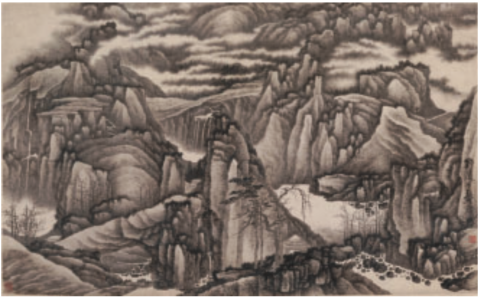
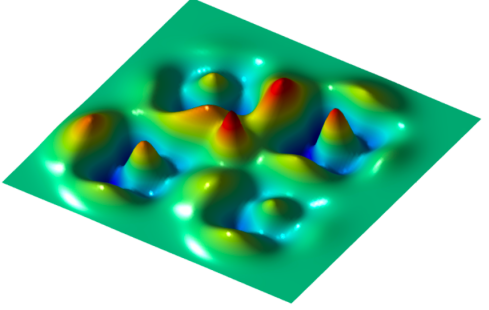
Figure 1 Left: “Thousands of Cliffs and Valleys” by Gong Xian (Qing Dynasty); Right: Schematic local view of the energy landscape of granular matter.
Contributor: Yu-Liang Jin