

Research Progress
Revealing Nature of Multiple Van Hove Singularities in Kagome Superconductors
Recently, the kagome lattice, characterized by its unique geometric frustration and electronic band features such as Van Hove singularities (VHSs) and Dirac cones, has emerged as a pivotal platform for exploring correlated physics and topological states of matter [1,2]. In particular, exotic quantum phenomena have been experimentally discovered in the AV₃Sb₅ family of kagome superconductors, including unconventional superconductivity, a time-reversal symmetry-breaking charge density wave (CDW) state, and electronic nematicity. In two-dimensional systems, VHSs give rise to a logarithmic divergence in the density of states, such that even weak electronic interactions can induce a rich variety of correlated electronic phases. Consequently, the intertwined quantum states observed experimentally are believed to be intimately linked to the multiple VHSs in the vicinity of the Fermi level, with the sublattice character of these VHSs in the kagome lattice directly influencing the resulting electronic correlated states [3–5]. Although the multiple VHSs in the AV₃Sb₅ system have been extensively investigated [6–8], the nature of these VHSs and their intrinsic connection to the unconventional charge order and superconductivity have remained subjects of debate.
To elucidate the characteristics and microscopic origin of VHSs in kagome metals, a collaborative team led by Prof. Xianxin Wu from the Institute of Theoretical Physics, Chinese Academy of Sciences, and Prof. Yong Hu from Chongqing University conducted a systematic investigation of the electronic structure and orbital characteristics across the entire AV₃Sb₅ family. By combining angle-resolved photoemission spectroscopy measurements with theoretical calculations, they found that the entire AV₃Sb₅ family exhibits highly consistent band features, providing a robust experimental foundation for a unified understanding of the physical mechanisms of VHSs and the diverse electronic phases they drive (Fig. 1). First, the study unambiguously identified multiple "pure-type" (p-type) VHSs in close proximity to the Fermi level across the AV₃Sb₅ family (Fig. 1, Fig. 2b). This finding stands in marked contrast to the "mixed-type" (m-type) VHSs inferred from prior theoretical calculations, thereby rectifying a misinterpretation regarding the nature of VHSs in this system. Second, the study revealed that strong d-p hybridization effects between the kagome and honeycomb sublattices, together with electronic correlation effects, constitute the key physical mechanism responsible for the p-type character of these VHSs. Furthermore, based on this redefined nature of the VHSs, the study provides a self-consistent explanation for the widely observed bond-order fluctuations and unconventional charge order in kagome superconductors. The findings indicate that p-type VHSs significantly enhance bond-order fluctuations (as illustrated in Fig. 2c), which aligns closely with experimental observations of the CDW, in contrast to the on-site charge fluctuation scenario previously associated with m-type VHSs.
This work not only provides direct experimental evidence for the precise nature of the VHSs in the AV₃Sb₅ kagome superconductors but also establishes a unified and broadly applicable electronic structure framework. It offers crucial physical insights for further understanding and exploring the microscopic origins of novel quantum states such as the CDW and superconductivity in this system. Moreover, these findings open new perspectives and physical avenues for tuning the electronic states in a wider range of kagome materials.
The above research was recently published in Physical Review Letters. Yujie Lan and Yuhao Lei from Chongqing University, along with Prof. Congcong Le from the Hefei National Laboratory, are the co-first authors of the paper. Prof. Xianxin Wu and Prof. Yong Hu are the co-corresponding authors. Prof. Xianxin Wu and Prof. Congcong Le provided the theoretical calculations and analysis. This research was supported by the National Key R&D Program of China, the National Natural Science Foundation of China, and the Chinese Academy of Sciences.
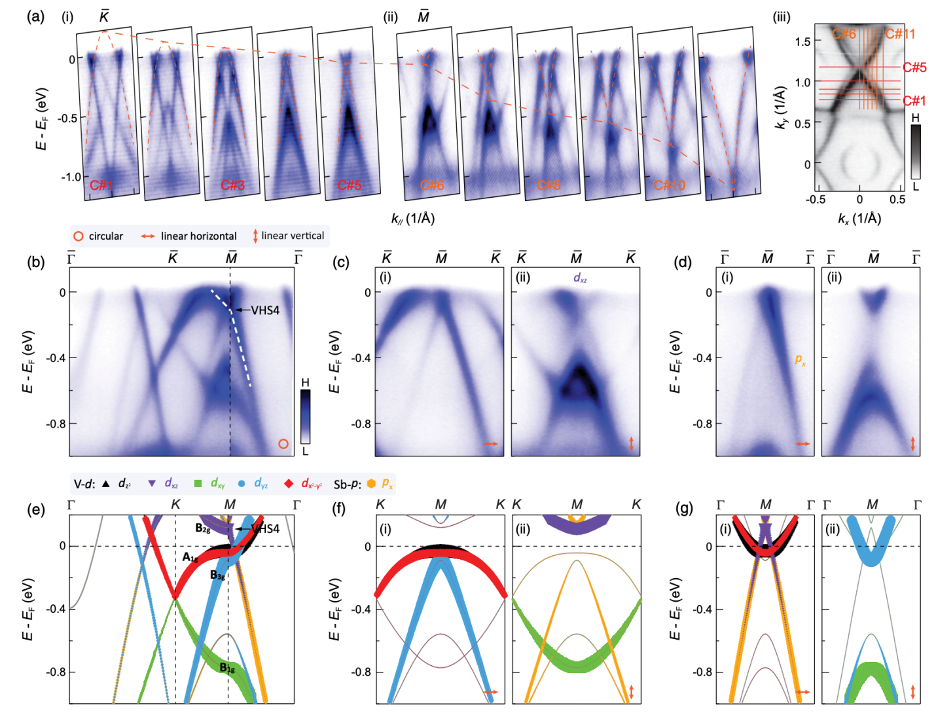
Figure 1. p-type VHS4 in CsV3Sb5. (a) Series of cuts taken vertically [(i)] and horizontally [(ii)] across the K − M path. (b)–(d) Polarization-dependent ARPES spectra along the Γ− K − M − Γ direction, measured with circular polarization (b), along the Γ −K (c) and Γ − M (d) directions, obtained with LH (i) and LV (ii) polarizations. (e) Orbital-resolved band structure along the Γ − K − M − Γ direction. (f),(g) Orbital-projected electronic structure of CsV3Sb5, showing orbitals favored under LH (i) and LV (ii) polarizations along the Γ − K − M (f) and Γ − M (g) directions.
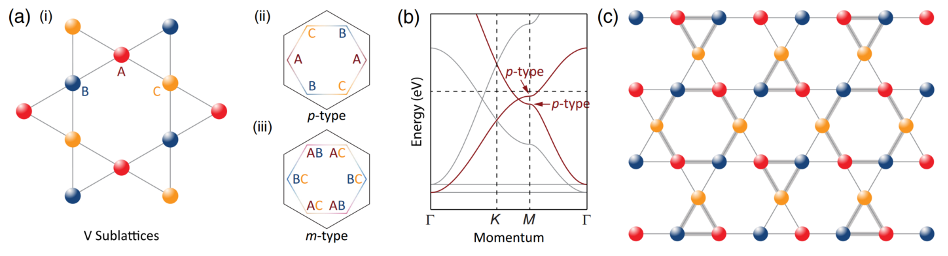
Figure 2. Twofold p-type VHSs assisted bond order fluctuations in AV3Sb5. (a) Illustration of three distinct sublattices (i) within the V kagome lattice, along with the classification of VHSs: p-type [sublattice-pure, (ii)] and m-type [sublattice-mixed, (iii)]. (b) Tight-binding model incorporating two orbitals to describe the twofold p-type VHSs. (c) Schematic representation of bond order fluctuations within the V kagome lattice.
Link: https://doi.org/10.1103/njg9-jpkh
Reference:
[1] Titus Neupert, M. Michael Denner, Jia-Xin Yin, Ronny Thomale,M. Zahid Hasan, Charge order and superconductivity in kagome materials, Nature Physics 18, 137 (2022).
[2] K. Jiang, T. Wu, J.-X. Yin, Z. Wang, M. Z. Hasan, S. D. Wilson, X. Chen, and J. Hu, Kagome superconductors AV3Sb5 (A = K, Rb, Cs), Natl. Sci. Rev. 10, nwac199 (2023).
[3] W.-S.Wang, Z.-Z. Li, Y.-Y. Xiang, and Q.-H.Wang, Competing electronic orders on kagome lattices at van hove filling, Phys. Rev. B 87, 115135 (2013).
[4] M. L. Kiesel, C. Platt, and R. Thomale, Unconventional fermi surface instabilities in the kagome hubbard model, Phys. Rev. Lett. 110, 126405 (2013).
[5] X. Wu et al., Nature of Unconventional Pairing in the Kagome Superconductors AV3Sb5 (A = K, Rb, Cs), Phys. Rev. Lett. 127, 177001 (2021).
[6] Y. Hu, X. Wu, et al., Rich nature of Van Hove singularities in Kagome superconductor CsV3Sb5, Nat. Commun. 13, 2220 (2022).
[7] M. Kang, S. Fang, et al., Twofold van Hove singularity and origin of charge order in topological kagome superconductor CsV3Sb5, Nat. Phys. 18, 301 (2022).
[8] Y. Hu, X. Wu, A. Schnyder and M. Shi, Electronic landscape of kagome superconductors AV3Sb5 (A = K,Rb,Cs) from angle-resolved photoemission spectroscopy, npj Quantum Materials 8, 67 (2023).
Contributor:Xian-Xin Wu