

Research Progress
Spin-orbit driven topological phases in kagome materials
Kagome materials have attracted widespread attention in condensed matter physics in recent years, owing to their rich physical phenomena such as geometric frustration, flat bands, Dirac cones, and unconventional electronic correlations. They are regarded as an important platform for exploring topological quantum states. However, in many typical kagome systems, the ideal topological properties are often obscured by bulk metallicity, which limits the clear identification and effective manipulation of the underlying physical mechanisms. Recently proposed two-dimensional and three-dimensional stacked honeycomb–kagome structures offer new material platforms for realizing ideal topological states. Nevertheless, most existing studies are based on spinless approximations, and a systematic understanding of how spin–orbit coupling (SOC) drives topological phase transitions and surface state evolution in these systems is still lacking.
Recently, a research team led by Associate Professor Tiantian Zhang from the Institute of Theoretical Physics, Chinese Academy of Sciences, published a paper entitled “Spin-orbit driven topological phases in kagome materials” in Physical Review B, which was selected as an Editors’ Suggestion. Focusing on the IAMX family of materials (IA: alkali metals, M: rare-earth elements, X: group-IV elements), the work systematically investigates their topological properties and proposes an effective model. It reveals that SOC can serve as a key tuning parameter for continuously controlling topological phases in such three-dimensional stacked honeycomb–kagome materials.
The study shows that, in the absence of SOC, the IAMX family can exhibit nodal-line semimetal behavior. As SOC increases, the system undergoes a sequence of topological phase transitions—from a nodal-line semimetal to a strong topological insulator, then to a critical gapless state, and finally to a Weyl semimetal—thereby forming a rich global topological phase diagram. Meanwhile, the surface states evolve continuously: when SOC is weak or acts as a small second-order perturbation, the system transitions from drumhead surface states in the SOC-free limit to Fermi arcs and helical surface states in the Weyl semimetal phase, and eventually merges into a single surface Dirac cone under strong SOC. This demonstrates a clear and unified correspondence between bulk topology and surface electronic structure.
To validate the proposed effective model, the researchers further performed first-principles calculations combined with tight-binding modeling on three representative materials with different SOC strengths: LiYC, LiNdGe, and KLaPb. A systematic analysis was carried out, including orbital composition and topological invariant calculations. The results show that these materials correspond to distinct topological phases in the weak, intermediate, and strong SOC regimes, respectively, occupying different regions of the unified phase diagram in full agreement with the model predictions. This demonstrates that the IAMX family provides an ideal material platform for studying SOC-driven topological phase transitions and surface state reconstruction.
This work provides a unified picture for understanding SOC-driven topological phase transitions in kagome materials and offers new strategies for topological phase engineering through chemical doping, element substitution, or isotope tuning. The results not only deepen the understanding of topological electronic structures in stacked honeycomb–kagome systems but also lay a theoretical foundation for designing quantum devices with tunable surface states and multiple topological functionalities.
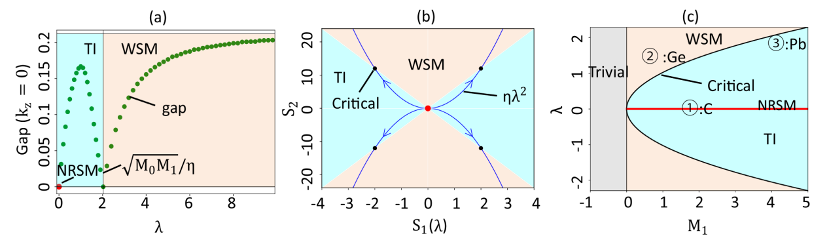
Figure 1: Phase diagram of the minimal k·p model. (a) Topological phase diagram as a function of the band gap in the plane and the spin–orbit coupling (SOC) strength λ . Gap closing serves as a signature of topological phase transitions. (b) Phase diagram as a function of the parameters S1 and S2 , which correspond to the first-order and second-order SOC terms, respectively. (c) Topological phase diagram as a function of SOC strength and intralayer hopping strength. The approximate parameter values and corresponding phase regions of LiYC, LiNdGe, and KLaPb are indicated by ①, ②, and ③, respectively.
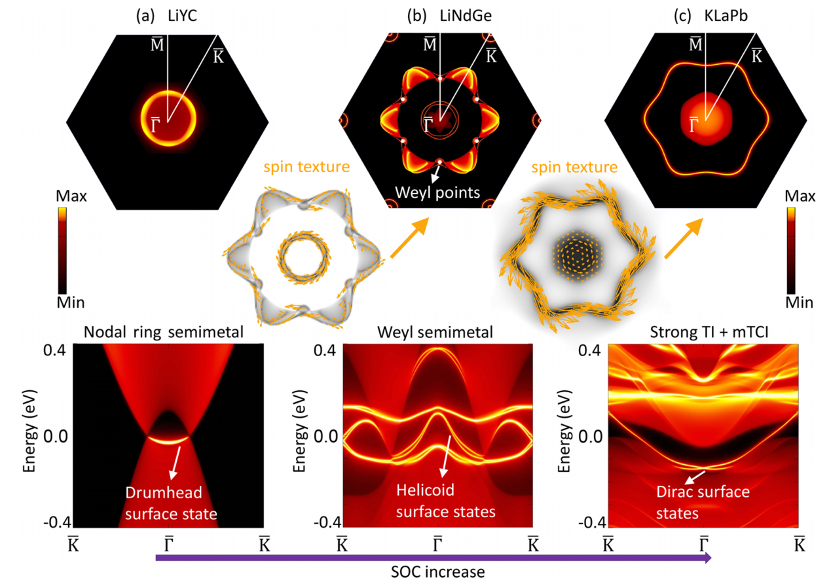
Figure 2: Projected surface states along the [001] direction and the corresponding Fermi surfaces of three IAMX materials, obtained from DFT+TB calculations. In these figures, bulk states are shown in black and dark red, while surface states are highlighted in gold. The surface spin textures of LiNdGe and KLaPb are indicated by orange arrows. (a) Fermi surface and drumhead surface states of LiYC. (b) Fermi arcs and helical surface states of LiNdGe, where each white dot represents the projection of a pair of Weyl points with opposite chirality. (c) Fermi surface and Dirac surface states of KLaPb.
Link: https://journals.aps.org/prb/abstract/10.1103/hckh-kxx5
Contributor:Tian-tian Zhang