

Research Progress
A New Mechanism for the Hyperuniform Distribution of Matter: The Coexistence of Criticality and Hyperuniformity
Recently, the statistical physics team (Pan Deng and Jin Yuliang) from the Institute of Theoretical Physics, Chinese Academy of Sciences, in collaboration with Shanghai Jiao Tong University and Zhejiang University, made progress in the field of disordered systems and statistical physics, revealing a new mechanism for the hyperuniform distribution of matter. The findings were published in the Proceedings of the National Academy of Sciences of the United States of America (PNAS) in 2026 under the title "Jamming as a topological satisfiability transition with contact number hyperuniformity and criticality." [1]
Hyperuniformity: A State of Matter that Suppresses Large-Scale Fluctuations
To understand the core discovery of this work, it is necessary to clarify the concept of "hyperuniformity." Hyperuniformity describes a state of matter where fluctuations in physical quantities such as density are anomalously suppressed at large scales. A common method to quantify this property (using density fluctuations as an example) involves placing an observation window of radius R within the system and calculating the variance of the number of particles N inside the window. In a completely random, uncorrelated system, this variance grows with the window's volume; whereas in a hyperuniform system, the variance grows more slowly, scaling proportionally to the window's surface area. This characteristic is also evident in Fourier space: the structure factor S(q) of a hyperuniform system tends to zero as the wavenumber q → 0 (Figure 1). Crystals represent an example of hyperuniformity, where fluctuations are completely dertermined by the particles on the window boundary.
Uniform, Hyperuniform, and Hyperfluctuating
Based on fluctuation behavior, states of matter can be divided into three categories. (1) Uniform systems. These systems exhibit normal fluctuations: the variance scales with the window's volume, commonly seen in ordinary liquids or gases. (2) Hyperfluctuating systems. These systems exhibit larger fluctuations than uniform systems. For example, near a critical point, fluctuations diverge, which is a typical hyperfluctuating behavior. (3) Hyperuniform systems. Fluctuations in hyperuniform systems are suppressed. This suppression can result from structural order (e.g., hyperuniformity in crystals) or from conserved physical quantities (e.g., charge conservation leading to hyperuniformity in ionic liquids).
The Hyperuniformity Puzzle in the Jamming Transition
The jamming transition is an non-equilibrium phase transtion in a disordered system between a flowing state and an amorphous solid state, commonly observed in colloids, granular materials, and amorphous materials. For a long time, this transition has presented a paradox: on one hand, it exhibits hyperuniformity, meaning large-scale fluctuations in physical quantities like density and contact number are significantly suppressed; on the other hand, it exhibits criticality, meaning the system shows high sensitivity to external perturbations and long-range correlations. From the description above, it is known that in typical systems, criticality often implies hyperfluctuations, not hyperuniformity. Why can these two seemingly contradictory phenomena coexist in the jamming transition?
A New Mechanism for Hyperuniformity: Coexistence of Hyperuniformity and Criticality
Through theoretical analysis and modelling, the research team uncovered the physical mechanism behind this paradox. They found that the contact number hyperuniformity in the jamming transition originates from two key constraints: a global isostatic condition and local mechanical stability inequalities. The former requires the overall system to satisfy a balance between the contact number and degrees of freedom. The latter required that the contact number of any subsystem must exceed the lower limit necessary for its mechanical stability. These two constraints work together to strictly restrict contact number fluctuations to a range proportional to the subsystem's surface area, naturally resulting in hyperuniformity. Crucially, the equality of the isostatic condition is only strictly satisfied at the critical point of the jamming transition; therefore, hyperuniformity and criticality are interconnected within this mechanism.
Based on this mechanism, the research team constructed a minimal topological network model (Net-I) that satisfies the constraints of the global equality and local inequalities. At the critical point, this model simultaneously exhibits connectivity number hyperuniformity and critical behavior. Numerical simulations show that the hyperuniformity indicators and critical exponents of this model in two, three, and four dimensions are consistent with results from frictionless granular jamming systems but differ significantly from the well-known Manna universality class. This suggests that the jamming transition may represent a completely new universality class of non-equilibrium phase transitions.
Significance and Extensions of the New Hyperuniformity Mechanism
This work provides a concise and profound physical picture for understanding the coexistence of hyperuniformity and criticality in disordered systems, revealing the central role of mechanical stability constraints in the structural formation of disordered materials. The results indicate that contact number hyperuniformity can exist independently of particle position hyperuniformity, offering new ideas for designing disordered materials with specific mechanical and optical properties. Furthermore, the hyperuniformity mechanism proposed in this study provides a theoretical tool for exploring spatial distribution behavior in a broader range of constraint satisfaction systems. A particularly intriguing direction for extension is whether density fluctuations in the cosmos exhibit similar hyperuniform behavior and whether a similar physical mechanism underlies them [2].
This work was supported by the National Natural Science Foundation of China and the Chinese Academy of Sciences.
[1] J. Shang, Y. Wang, D. Pan, Y. Jin, J. Zhang, Jamming as a topological satisfiability transition with contact number hyperuniformity and criticality, PNAS, 123 (14) e2517241123 (2026).
[2] O. H. E. Philcox and S. Torquato, "Disordered heterogeneous Universe: Galaxy distribution and clustering across length scales," Phys. Rev. X 13, 011038 (2023).
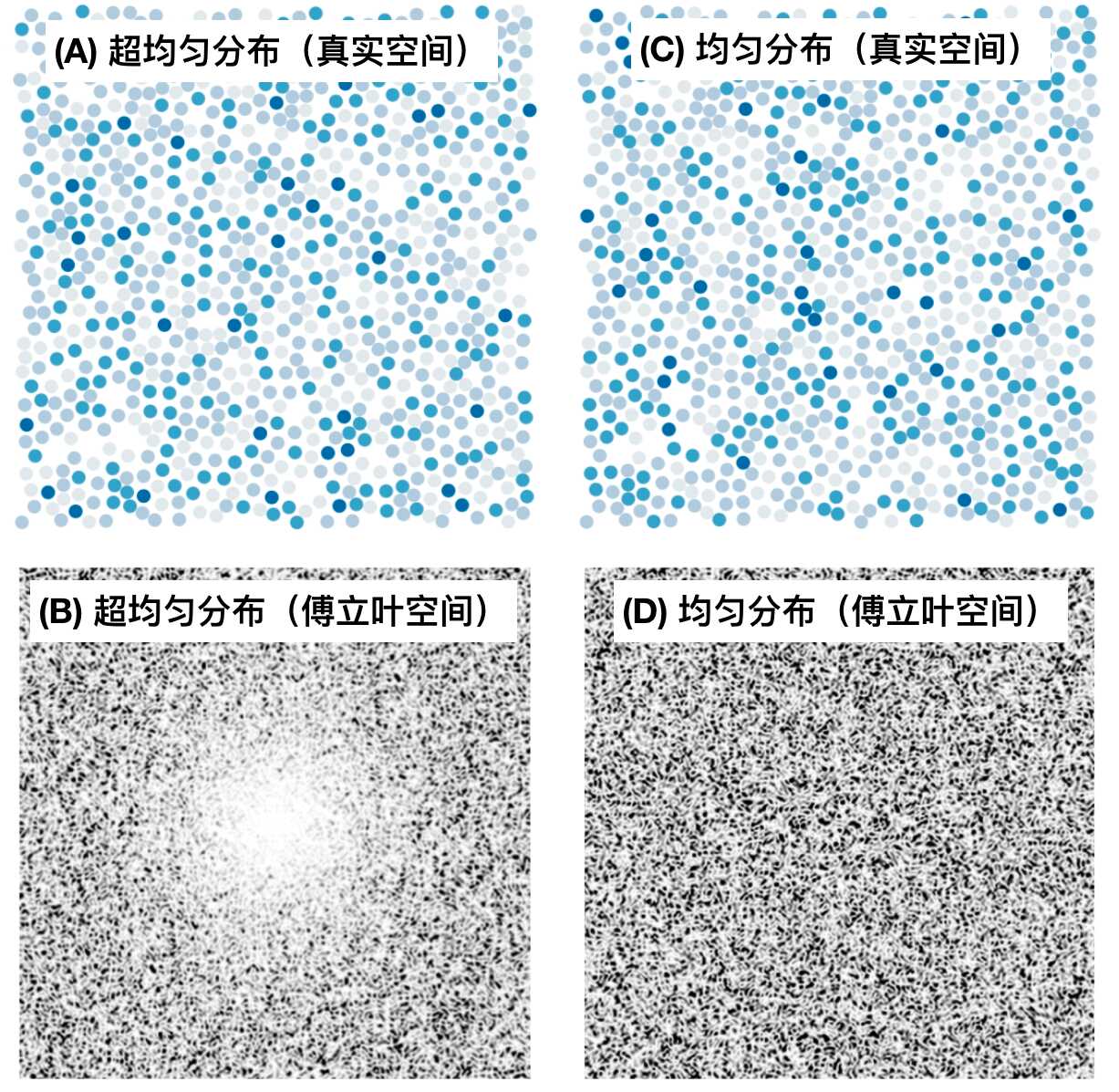
Figure 1. Comparison of hyperuniform and uniform distributions. (A, C) show the spatial distribution of particles, with colors representing contact numbers. (B, D) show the structure factor SZ(q) after Fourier transform of the contact number correlation function. The difference between hyperuniform and uniform distributions is more easily visualized in the Fourier space: SZ(q) tends to zero as q → 0 for the hyperuniform system.