

Research Progress
How to Optimize Quantum Circuits in Quantum Computers
Quantum circuits form the core of quantum computers, dedicated to executing a wide range of quantum computing tasks. However, in contrast to traditional classical circuits, quantum circuits face numerous technical challenges. In the stage of quantum state preparation, minimizing resource consumption—such as reducing the number of quantum gate operations and lowering circuit complexity (i.e., circuit depth)—is a critical scientific issue that demands urgent solutions. These factors not only directly determine the operational efficiency and scalability of quantum algorithms but also are closely linked to mitigating noise interference and enhancing quantum state stability, serving as essential prerequisites for advancing the practical application of quantum computing. For this reason, scientists have long grappled with a core dilemma: to prepare a specific quantum state, an overly shallow quantum circuit leads to inaccurate state preparation, while an excessively deep one results in a waste of resources. So, how deep should a quantum circuit be to be "just right"?
Recently, a research team led by Professor Gang Su from Institute of Theoretical Physics of Chinese Academy of Sciences, and Professor Shiju Ran (Young Visiting Scientist at the Peng Huanwu Center for Theoretical Physics of ITP-CAS and faculty at Capital Normal University), in collaboration with Associate Professor Wenjun Li from Putian University and undergraduate student Shuo Qi from CNU, proposed a class of multipartite entanglement measures enabling the characterization of the optimality of quantum circuits for state preparation. By analyzing the scaling relationship between many-body entanglement entropy and fidelity to optimize quantum circuits, they provided a practically implementable solution to the aforementioned dilemma. This work integrates quantum entanglement, tensor networks, and quantum computing implementation, boasting significant theoretical value and broad application prospects. The relevant article was recently published in Physical Review Letters 136, 020602 (2026).
The extraordinary power of quantum computing is largely attributed to the fascinating phenomenon of quantum entanglement. Simply put, entanglement refers to a special quantum correlation between multiple particles—even when separated by vast distances, a change in the state of one particle instantaneously affects the others. We typically use bipartite entanglement to describe such correlations between two particles, which has demonstrated important application value in numerous fields. Nevertheless, when it comes to describing more complex and large-scale quantum systems—for instance, scenarios involving the synergy of hundreds or even tens of thousands of particles—relying solely on bipartite entanglement is clearly insufficient. At this point, many-body entanglement becomes the key to understanding and harnessing these complex quantum systems.
For complex quantum systems, tensor networks offer a new perspective for understanding many-body entanglement and serve as a powerful mathematical tool. A tensor network can be envisioned as an elaborate "building block" structure: each tensor block represents a portion of the information in the quantum system, and connecting these blocks in a specific manner constructs the quantum state of the entire system. Among them, Matrix Product States (MPS) are the most common and highly important form of tensor networks. MPS is particularly effective for one-dimensional quantum many-body systems, and its complexity can be regulated by a parameter known as the "bond dimension" χ.
Based on tensor networks, the research team innovatively took MPS as the reference manifold and proposed a brand-new many-body entanglement measure, introducing a new physical quantity: χ-specified matrix product entanglement (χ-MPE). Its core idea is as follows: unlike traditional geometric entanglement, which only considers the distance from the product state manifold and fails to effectively reflect the complex structure of many-body entanglement, χ-MPE compares the target quantum state with the "optimal" tensor network state. Here, "optimal" refers to the minimum fidelity distance between the target state and the MPS manifold with a specific bond dimension χ. This can be understood as follows: instead of directly measuring how "entangled" a state is, we measure how far it is from the "closest" quantum state (MPS) with constrained complexity (determined by χ). When χ = 1, the MPS degenerates into the simplest "product state", and χ-MPE then becomes the familiar "geometric entanglement", which measures the distance from a state with no entanglement at all (the product state). As χ increases, the range of entangled states covered by the manifold gradually expands, and χ-MPE measures the distance from more complex entangled states (MPS) that are still constrained by a specific complexity (χ), as illustrated in the figure below.
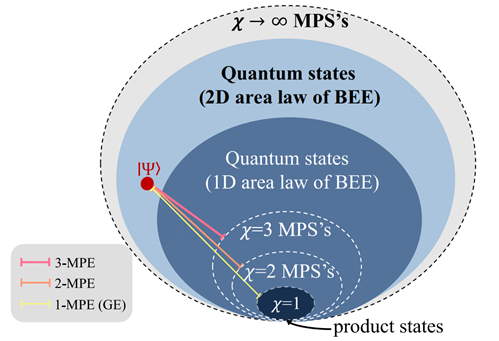
The research team further established a connection between χ-MPE and the "depth (D)" of variational quantum circuits. In quantum computing, circuit depth (i.e., the number of layers of connected quantum gates) is directly related to computational efficiency, sensitivity to noise, and resource requirements. The study found a fascinating scaling relationship between χ-MPE and the fidelity (F) of preparing the target state with a quantum circuit (a metric for how close the prepared state is to the target state). Through theoretical derivation and numerical simulation, they revealed three important scaling behaviors:
(1) Superlinear Scaling: When χ-MPE grows too rapidly relative to the negative logarithmic fidelity (F) of state preparation, it indicates that the depth D of the quantum circuit is "excessive". In other words, the circuit is too deep, resulting in a waste of quantum resources.
(2) Linear Scaling: When χ-MPE has an approximately linear relationship with F, it signals that the depth D of the quantum circuit is "optimal". At this point, the circuit depth is "just right". The article also provides a rigorous proof: for the MPS manifold with χ = 2, the state space it represents is exactly equivalent to the state space achievable by a single-layer quantum circuit (D = 1), thus establishing a theoretical correspondence between circuit depth and entanglement structure.
(3) Sublinear Scaling: When χ-MPE grows too slowly relative to F, it means that the depth D of the quantum circuit is "insufficient", i.e., the circuit is too shallow.
χ-MPE innovatively provides a novel and controllable method for quantifying many-body entanglement. Tightly integrated with tensor networks, it offers a new tool for understanding complex quantum systems. By analyzing the scaling relationship between χ-MPE and fidelity, one can directly judge whether the depth of a given variational quantum circuit is optimal, thereby guiding the design and optimization of quantum algorithms, reducing resource consumption, and improving the efficiency and robustness of quantum computing—making it a powerful tool for quantum circuit optimization. In addition, this tensor network-based method can be extended to other types of tensor network structures, enabling the evaluation of the optimality of a broader range of quantum circuits in preparing various tensor network states.
This research was supported in part by projects from the Ministry of Science and Technology of China, the Chinese Academy of Sciences, the National Natural Science Foundation of China, and the Beijing Municipal Government.
Contributor:Gang Su