

Research Progress
Higher-Order Vortex States and Magnon Orbital Angular Momentum Hybridization in Magnetic Nanotubes
In the frontier fields of condensed matter physics and spintronics, magnetic materials with noncollinear spin structures and exotic topological textures have long been a research focus. In particular, curved magnetic materials feature a direct coupling between geometric curvature and spin configurations, which can stabilize noncollinear arrangements and complex spin textures that are hard to exist in planar systems. This not only provides a unique perspective for exploring novel physical phenomena but also builds an ideal platform for the development of next-generation spintronic devices.
In recent years, with the discovery of two-dimensional van der Waals magnets and advances in the synthesis technology of transition metal chalcogenide nanotubes, it has become possible to construct intrinsic magnetic nanotubes. Such systems skillfully integrate curvature tunability with the rich spin physical properties of van der Waals magnets, emerging as an ideal system for studying curvature-driven magnetic phenomena and forming a new research direction of curvature magnetism.
Recently, a joint research team led by Professor Gang Su, Professor Bo Gu, and Dr. Jiawen Li from Institute of Theoretical Physics of Chinese Academy of Sciences, University of Chinese Academy of Sciences, and National Center for Nanoscience and Technology has achieved important progress in the study of VSe2 single-walled nanotubes. Using multiple approaches including density functional theory, Heisenberg model modeling, and Landau-Lifshitz-Gilbert (LLG) equation, they systematically investigated the magnetic ground state of VSe2 nanotubes, for the first time discovering diameter-tunable higher-order vortex states and the phenomenon of magnon orbital angular momentum hybridization, and proposing a brand-new mechanism for generating magnons with high orbital angular momentum. Since such magnons are insensitive to external disturbances, they possess unique advantages in information transmission and storage. The relevant research results were recently published in Physical Review Letters 136, 096703 (2026).
In two-dimensional magnets, magnetic anisotropy energy plays a pivotal role in stabilizing long-range magnetic order. Its exchange interaction can be effectively regulated by means of strain, charge doping, and interface effects, thus facilitating the formation of topological spin structures. When a magnet takes a curved form, geometric curvature induces an interaction analogous to the Dzyaloshinskii–Moriya interaction, breaking spatial inversion symmetry and thereby generating nontrivial topological structures. Compared with planar magnets, nanotubes have circumferential periodic boundary conditions, a well-defined geometric phase, and a winding structure, making them an ideal model system for studying curvature-spin coupling.
This study focused on the magnetic ground state of VSe2 single-walled nanotubes and achieved the following major advances:
(1) Discovery of a new type of higher-order magnetic vortex state in VSe2 nanotubes. Over a wide range of diameters, the ground state of VSe2 nanotubes was found to be a novel higher-order 3φ magnetic vortex state that can form an eight-petal magnon density pattern, as shown in Figure 1. This exotic state represents a new type of stable noncollinear topological ordered state discovered in quasi-one-dimensional systems.
(2) Elucidation of the formation mechanism of nφ vortex states with winding number n≥1. By constructing a theoretical model incorporating three types of Heisenberg coupling interactions as well as axial and radial magnetic anisotropies, it was found that the delicate competition between short-range ferromagnetic exchange (J1), long-range antiferromagnetic exchange (J2, J3), and magnetic anisotropic interactions jointly stabilizes magnetic vortex states with different winding numbers n. The obtained phase diagram is consistent with the results of density functional theory calculations, indicating that this multi-factor competition mechanism may serve as a general principle for designing complex spin textures in curved magnets. Conventional magnetic vortex states (n=1) can be studied using continuum theory, while higher-order vortex states (n≥2) are more complex, discrete spin configurations whose formation mechanism goes beyond the description of simple continuum models.
(3) Discovery of the hybridization phenomenon of magnon modes with different orbital angular momenta through LLG dynamic calculations. It was proven that higher-order vortex states (n>1) can provide a magnon mode hybridization mechanism governed by the orbital angular momentum selection rule (∆l = ±2(n-1)) in the presence of magnetic anisotropy, a hybridization that does not exist in ordinary vortices (n=1). This discovery offers a novel and practical approach for generating and regulating magnons with high orbital angular momentum. Studies have shown that the orbital angular momentum hybridization mechanism in higher-order vortex states has the potential to open a band gap in the magnon energy band when the magnetic anisotropy is sufficiently strong, which is crucial for the construction of magnonic devices.
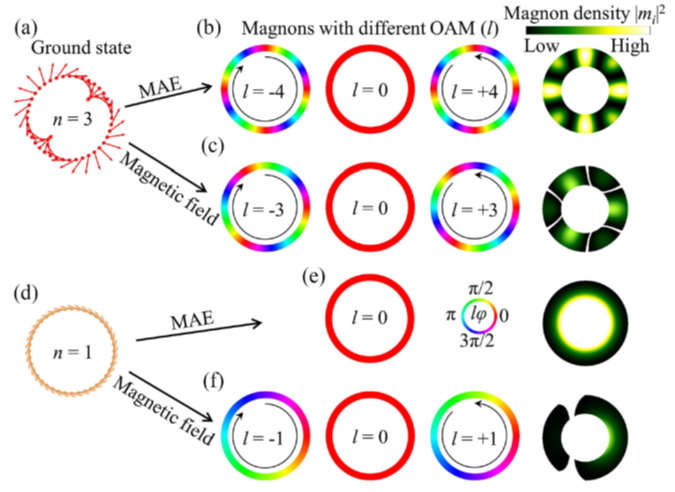
Figure 1 Schematic diagram of orbital angular momentum hybridization of magnon modes in vortex states, showing mode coupling and magnon density distribution in higher-order vortex states.
Through the specific case of VSe2 nanotubes, this study not only profoundly reveals the decisive influence of geometric shape on microscopic magnetism but also extends the research on magnetic vortex states to a new higher-order category. It provides a feasible new idea for the intrinsic generation and regulation of magnons with high orbital angular momentum inside materials, representing a new progress in the research of curvature magnetism. Since magnetic vortex states with high orbital angular momentum can carry richer information and exhibit excellent anti-interference ability, VSe2 nanotubes, as a highly promising platform, are expected to play an important role in exploring complex magnetic phenomena and developing next-generation magnonic and spintronic devices in the future.
This study was supported in part by the Ministry of Science and Technology of China, the National Natural Science Foundation of China, and the Chinese Academy of Sciences.
Contributor:Gang Su