

Research Progress
Third law of repetitive electric Penrose processes
Recently, PhD student Hu Li from the Hangzhou Institute for Advanced Study, UCAS, Professor Rong-Gen Cai from Ningbo University, and Associate Researcher Shao-Jiang Wang from the Institute of Theoretical Physics, Chinese Academy of Sciences, published a Letter in Physical Review D titled "Third law of repetitive electric Penrose processes" (Phys. Rev. D 113 (2026) 6, L061501). This study discovered a third-law analog in the repetitive electric Penrose process within the spacetime of a charged black hole. The research shows that the repetitive electric Penrose process, which extracts energy from a black hole by repeatedly using charged particles, cannot reduce the black hole's charge to zero. This is analogous to the third law of thermodynamics, which states that absolute zero cannot be reached. Therefore, to completely neutralize its charge, a charged black hole must either undergo a non-Penrose process by accidentally absorbing oppositely charged particles, or evaporate over a long period via Hawking radiation.
The key finding of this research is that while repeatedly using particle decay processes near a charged black hole (the electric Penrose process) can potentially reduce the black hole's charge to an extremely low level, it can never be completely neutralized. This is because the conditions required for the Penrose process to occur will inevitably be violated before complete neutralization. Furthermore, since each energy extraction converts a portion of energy into the black hole's "irreducible mass" (i.e., an increase in entropy), this part of the energy is permanently locked away according to the second law of thermodynamics, preventing the full utilization of the black hole's electrical energy.
In the 1970s, J. D. Bekenstein and S. W. Hawking discovered the four laws of black hole dynamics and their correspondence with the four laws of thermodynamics. The third law of black hole thermodynamics asserts that if the energy-momentum tensor is bounded and satisfies the weak energy condition, the surface gravity of the black hole (corresponding to its Hawking temperature) cannot be reduced to zero in a finite time. Separately, the Penrose process is a famous mechanism proposed by R. Penrose and R. M. Floyd: a particle falls into the ergosphere of a rotating black hole and splits. One part falls into the black hole (carrying away negative energy), while the other escapes (gaining more energy), thereby extracting the black hole's rotational energy. This idea was later extended to charged black holes (the electric Penrose process) to extract electrostatic energy using charged particles. Recently, Ruffini et al. published a paper (Phys. Rev. Lett. 134 (2025) 8, 081403) pointing out that for a rotating black hole, repeating the Penrose process cannot extract all its available energy, as each extraction increases the black hole's "irreducible mass" (the area of its event horizon). According to Hawking's area theorem, this energy can never be retrieved. The question then arises: does a similar limitation exist for the repetitive electric Penrose process in charged black holes? Can a black hole's charge be completely neutralized through repeated discharges? This is precisely the question this research aimed to explore.
The researchers first analyzed the condition for maximizing the efficiency (EROI, defined below) of a single electric Penrose process: the incident particle decays near the black hole into two charged particles, one with negative energy falling into the black hole and the other with positive energy escaping. To maximize the efficiency of each extraction, they required all three particles to have zero radial momentum at the decay point (i.e., to be at their turning points). By solving the conservation laws for energy and charge, along with the normalization condition for the four-velocity, they derived constraints relating the particle parameters and the black hole's charge. They then simulated the repeated process: after each extraction, the black hole's mass and charge were updated and used as the initial conditions for the next step. They focused particularly on two termination conditions: (1) the energy of the infalling particle must be negative (otherwise, no energy could be extracted), and (2) the escaping particle must be able to reach infinity (it cannot fall back into the black hole). These conditions set a lower limit on the black hole's charge. Finally, they calculated the Energy Return on Investment (EROI, the ratio of energy extracted to energy invested) and the Energy Utilization Efficiency (EUE, the ratio of energy extracted to the decrease in the black hole's extractable energy), and explored the influence of various parameters.
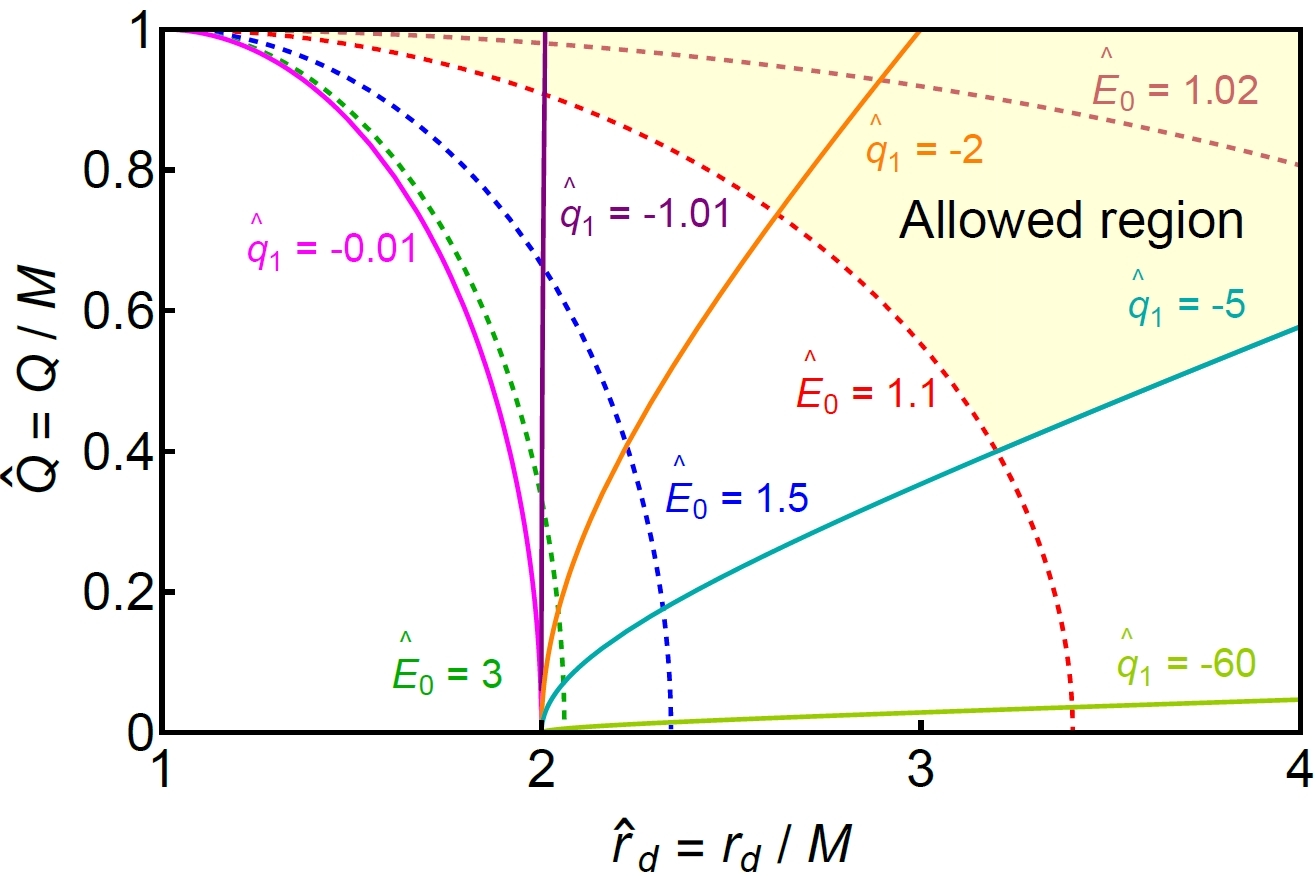
[Figure: Allowed parameter space constrained by the two termination conditions for the electric Penrose process]
The research shows that even with repeated electric Penrose processes, the black hole's charge can only approach zero infinitely closely, but can never be completely neutralized through this process alone. This is because during the repetitive process, one of the two termination conditions will inevitably be triggered at some point. If the particle decay process were to continue, either the energy of the particle falling into the black hole would become positive (meaning it's a non-Penrose process that doesn't extract energy; although the black hole's charge would still decrease, this is equivalent to a charge neutralization process without particle decay), or the particle attempting to escape would ultimately fall back into the black hole (also a non-Penrose process that doesn't extract energy and, according to charge conservation in the decay process, effectively results in the black hole absorbing the charge of the pre-decay particle, thereby increasing its charge). Furthermore, the electrical energy of the black hole is not fully utilized during the repetitive process. This is because each extraction irreversibly converts a portion of the extractable energy into the black hole's irreducible mass (entropy). This portion of energy is permanently locked away and cannot be released through classical processes. Numerical simulations show that the energy return on investment can easily exceed 100%, but the energy utilization efficiency rarely surpasses 50%. This means that most of the extractable energy is ultimately "wasted" on the nonlinear growth of the black hole's entropy.
This discovery reveals a fundamental thermodynamic limitation in the process of extracting energy from black holes, analogous to the third law of thermodynamics (the impossibility of reaching absolute zero through a finite number of operations). In the future, the researchers plan to extend this analysis to Kerr-Newman black holes, which possess both rotation and charge, and to explore whether a similar limitation exists for the corresponding wave process (superradiance). Furthermore, they ask: does a similar third-law formulation exist for repetitive Penrose processes in general charged black hole spacetimes? These studies will contribute to a deeper understanding of the nature of black holes as thermodynamic systems.
This research was supported by the National Key Research and Development Program of MOST, and the National Natural Science Foundation of China (the Excellent Young Scientists Fund, the Special Fund for Theoretical Physics, The Science Fund for Excellent Research Groups, the Key Program, and the Peng Huanwu Innovation Research Center for Theoretical Physics).
Contributor:Shao-jiang Wang