

Research Progress
A Universal Theory for the Aging Phenomenon in Glassy Materials
Recently, the Statistical Physics team (Li Bin, Pan Deng, Qu Ting, Jin Yuliang) at the Institute of Theoretical Physics, Chinese Academy of Sciences, has made a breakthrough in the study of aging dynamics in glassy materials. They proposed a "Generalized Trap Model" (GTM) that successfully unifies the description of aging behaviors in both spin and structural glasses, and reveals the universal laws governing the occurrence of "weak ergodicity breaking." The results were published in Science Advances on February 27, 2026, under the title "Universal activated aging and weak ergodicity breaking in spin and structural glasses."
Glassy materials (such as spin glasses, colloidal glasses, and amorphous silica) possess unique thermodynamic and dynamic properties. From a thermodynamic perspective, glassy systems feature a vast number of metastable states separated by multi-scale energy barriers, corresponding to a complex energy landscape. From a dynamic perspective, these systems are in non-equilibrium states, with their physical properties continuously evolving over time. Notably, the relaxation processes in glassy systems gradually slow down as time progresses, a phenomenon known as "aging." Understanding the mechanism of aging is a major challenge in non-equilibrium statistical physics. Previously, the "trap model" proposed by Bouchaud could qualitatively describe aging, but its core predictions—especially the temperature at which weak ergodicity breaking occurs—showed significant contradictions with computer simulation results of classic spin glass models like the Random Energy Model (REM).
To unravel this puzzle, the research team delved into the root cause of the discrepancies. They discovered that the original trap model overlooked the Gaussian correction terms in the energy barrier distribution arising from finite-size effects. Based on this insight, the team constructed the GTM. The key predictions of this model are:
(1) Two-step ergodicity breaking: During cooling, the system first undergoes weak ergodicity breaking at a higher temperature, i.e., ergodicity breaking in non-equilibrium aging dynamics. Only when the temperature is lowered further does strong ergodicity breaking occur in equilibrium dynamics (corresponding to the glass transition).
(2) Inference of activated region size: The model indicates that the logarithmic decay behavior of the two-time correlation function during aging is directly related to the characteristic size of the local region where activated events occur. This implies that by analyzing aging dynamics data, one can infer a static characteristic length.
To validate these theoretical predictions, the research team conducted simulation tests on four typical glass models:
(1) Spin glass models: Including the Gaussian Random Energy Model (G-REM) and the Exponential Random Energy Model (E-REM). Using a "barrier tree" algorithm and Monte Carlo simulations, the team verified for the first time that the energy barrier distribution in G-REM indeed contains Gaussian correction terms, which are the reason for the discrepancy with the original trap model's predictions. The GTM nicely fits the simulation data from both REMs, demonstrating that the weak ergodicity breaking temperature is indeed higher than the strong ergodicity breaking temperature.
(2) Structural glass models: Including the Weeks-Chandler-Andersen (WCA) model and the amorphous silica model. In these two models, which are closer to real materials, the GTM also successfully describes the aging behavior.
Most importantly, by applying the GTM theoretical framework to the WCA model, the research team successfully extracted a static length from its non-equilibrium aging dynamics. This length, deduced from dynamics, perfectly falls on the same growth curve as static lengths measured by complex equilibrium methods (such as the point-to-set length) and the Hessian matrix method (Figure 1, left). Previously, due to difficulties in equilibrium simulations, the observable growth range of these static lengths was only about two to three times. The new method extended this range to a full order of magnitude. This curve aligns with the predictions of the Random First-Order Transition (RFOT) theory, providing strong evidence for this important theoretical picture.
Ultimately, all research findings are synthesized into a unified aging phase diagram (Figure 1, right). This phase diagram, based on two key temperatures (the weak ergodicity breaking temperature and the strong ergodicity breaking temperature), clearly delineates the ergodic states and weak ergodicity breaking states in spin and structural glasses, illustrating the universality of aging behavior in glassy states.
This work not only resolves the long-standing contradiction between Bouchaud's trap model and simulations/experiments but also establishes a universal theoretical framework, offering a novel perspective for understanding the aging dynamics of glassy materials. The method of extracting static lengths from dynamics also opens up new avenues for studying static correlations in a wider range of glassy systems that have strong aging effects. This achievement holds significant theoretical importance and potential application value for understanding the nature of the glass transition and developing new amorphous materials.
This research was supported by projects from the National Natural Science Foundation of China, the National Key R&D Program of China, the Chinese Academy of Sciences, and the Wenzhou Institute.
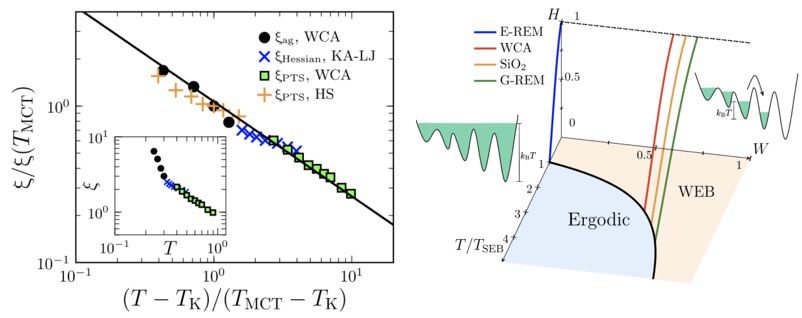
Figure 1. (Left) Comparison of the static length extracted from non-equilibrium aging dynamics with static lengths measured by other methods and the RFOT theory (solid line). (Right) Unified aging phase diagram for spin and structural glasses.
DOI: 10.1126/sciadv.aec4416