

General ab initio framework for electronic-order-induced symmetry breaking in lattice dynamics
Research Background
In condensed matter physics, the magnetic ordering of electrons leads to the spontaneous breaking of time-reversal symmetry (TRS) in a system. Currently, first-principles calculations can relatively accurately describe the magnetic order of electronic systems and the associated TRS breaking. For a long time, however, conventional first-principles methods have failed to correctly describe the TRS breaking of lattice dynamics in magnetic systems. This limitation arises because traditional methods rely solely on force constants and the dynamical matrix; since the total energy (and thus the force constants) of a system is inherently real, the dynamical matrix naturally enforces TRS upon the phonon dynamics. This has long restricted quantitative theoretical investigations into phenomena such as electron-phonon coupling, phonon magnetism, and Hall-like lattice responses. Recently, the phonon TRS breaking induced by electronic magnetic order was experimentally observed for the first time in the ferromagnetic Weyl semimetal Co₃Sn₂S₂ [1,2], further highlighting the urgent need to develop first-principles computational methods capable of correctly and quantitatively describing this effect.
Algorithm Improvement
In 1979, the pioneering work of Mead and Truhlar laid the theoretical foundation for this class of first-principles computational methods [3]. They pointed out that during the adiabatic evolution of electrons following the positions of ionic cores, the electrons contribute an equivalent external field to the lattice dynamics, a correction that is vital for phonon dynamics. In 1984, Berry's theory demonstrated that this equivalent external field affecting lattice dynamics is precisely the Berry curvature of electrons in the parameter space of ionic core positions [4]. Today, this specific Berry curvature in the parameter space of ionic positions is designated as the Molecular Berry Curvature (MBC). Recent theoretical studies have shown that the molecular Berry curvature vanishes unless the electronic ground state breaks time-reversal symmetry [5-8]. These findings demonstrate that to correctly describe time-reversal symmetry in phonon dynamics, first-principles algorithms must incorporate quantum geometric effects.
However, there is currently no well-established, universal first-principles software that incorporates such quantum geometric effects into the description of lattice dynamics. To establish a first-principles theoretical framework for electronic-order-induced symmetry breaking in lattice dynamics, Assoc. Prof. Tiantian Zhang’s group at the Institute of Theoretical Physics, Chinese Academy of Sciences, has developed a brand-new ab initio algorithm based on the molecular Berry curvature theory to correctly describe the symmetry of lattice dynamics in magnetic systems. By employing a linear response approach, this algorithm expresses the molecular Berry curvature in terms of electron-phonon coupling matrices and significantly enhances computational efficiency through Wannier interpolation. This algorithm successfully captures the time-reversal symmetry breaking of lattice dynamics induced by electronic magnetic ordering (Fig. 1). This breakthrough enables quantitative investigations into the time-reversal symmetry breaking of lattice dynamics and its associated transport effects (e.g., the phonon Hall effect) in complex systems.
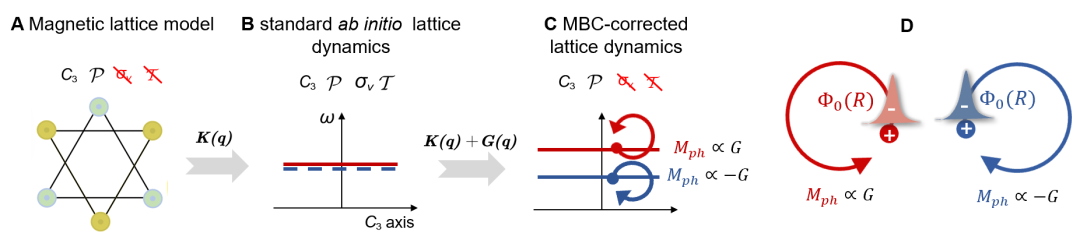
Figure 1. Schematic of the ab initio computational framework based on Molecular Berry Curvature (MBC) theory. (A) The lattice preserves three-fold rotational, inversion, vertical mirror, and time-reversal symmetries. A collinear ferromagnetic order oriented along the three-fold rotational axis and parallel to the vertical mirror plane simultaneously breaks both the vertical mirror and time-reversal symmetries. (B) Phonon spectra obtained from conventional first-principles calculations fail to reflect the breaking of mirror and time-reversal symmetries induced by magnetic ordering, yielding doubly degenerate phonon dispersions. (C) By incorporating the MBC matrix into lattice dynamics, our algorithm accurately captures the symmetry breaking in the phonon spectra of magnetic materials. (D) Schematic illustration of the MBC generated during the adiabatic evolution of the electronic ground state under different phonon modes. Phonon modes with opposite circular polarizations acquire MBC corrections of opposite signs.
Algorithm Validation
To validate the effectiveness of the proposed algorithm, Zhang’s research group calculated the phonon spectrum of Co₃Sn₂S₂ as a benchmark case. The results demonstrate that the phonon spectrum simultaneously exhibits the breaking of both time-reversal and mirror symmetries, quantitatively reproducing the experimental phonon splitting phenomenon.
Above 175 K, Co₃Sn₂S₂ is in a paramagnetic state, possessing symmetries that include three-fold rotational, inversion, mirror, and time-reversal symmetries. These symmetries protect the strict degeneracy of the Eg and Eu phonon modes along the paths parallel to the C3 axis. As the temperature drops below 175 K, the system develops a ferromagnetic order (Fig. 2A), which breaks both the time-reversal and mirror symmetries of the system. Experimental studies have shown that below 175 K, the phonon spectra of the Eg and Eu modes undergo splitting [1,2]. However, conventional first-principles algorithms fail to correctly describe the time-reversal symmetry breaking of lattice dynamics induced by electronic order; even when the ferromagnetic ground state and spin-orbit coupling (SOC) are incorporated into the calculations, the phonon spectra of the Eg and Eu modes remain degenerate (Fig. 2C).
Upon incorporating the MBC, the computational results reveal that the degeneracy of the Eg modes along the C3 axis is lifted (Figs. 2D and 2E). The maximum splitting occurs at the Γ point, reaching a value of 0.253 meV (2.05 cm-1). This value is in reasonable agreement with the experimentally measured value (1.27 cm-1). This confirms that the proposed first-principles algorithm is capable of quantitatively describing the breaking of both time-reversal and mirror symmetries in lattice dynamics.
The behavior of the Eu mode is different from that of the Eg mode. After considering the MBC, the splitting of the Eu mode at the Γ is only about 0.002 meV (0.016 cm-1) (Fig. 2H, I), which is far smaller than the experimental observation value (0.3 cm-1). This indicates that the main mechanism causing the splitting of Eg and Eu modes may be different. Further analysis shows that the asymmetric lineshape of Eu indicates that it has a large Fano resonance effect. After including the Fano factor correction, the obtained splitting of the Eu mode is in high agreement with the experimental data.
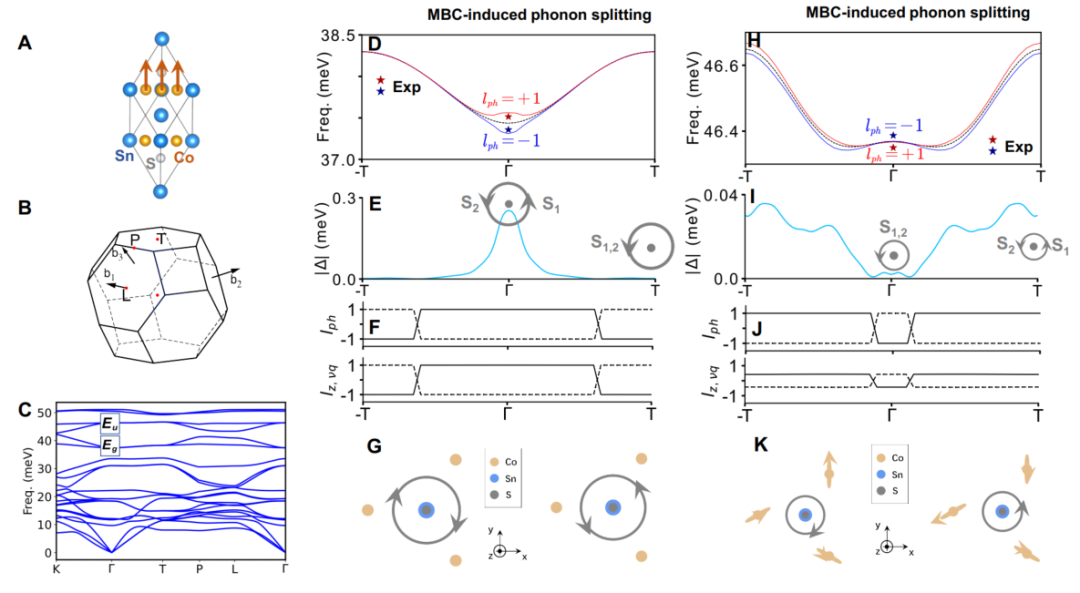
Figure 2. Calculated phonon spectra of Co3Sn2S2. (A) Crystal structure of Co3Sn2S2. (B) Brillouin zone. (C) Phonon spectrum without incorporating the MBC. (D) Phonon spectrum of the Eg modes with the inclusion of the MBC contribution. (E) Phonon splitting magnitude of the Eg modes. (F) Correspondence between the pseudo-angular momentum and angular momentum of the Eg phonon modes. (G) Atomic vibration patterns of the Eg modes. (H–K) Corresponding plots and contents for the Eu modes.
Furthermore, leveraging this algorithm, the research team predicted several candidate materials that exhibit phonon time-reversal symmetry breaking induced by electronic magnetic order, thereby providing clear directions for future experimental explorations. This algorithm establishes a universal computational framework for understanding electron-phonon coupling, phonon magnetism, and Hall-like lattice responses from first principles, which is of great significance for advancing quantitative studies of phonon transport and optical properties. The phonon dynamics calculation code incorporating the MBC correction is openly accessible on Tiantian Zhang’s homepage (https://brillianttt.github.io/itp-dft-homepage/index.html).
This work was recently published in Science Advances (DOI: 10.1126/sciadv.aed7081). Shuai Zhang, an Assistant Research Fellow at the Institute of Theoretical Physics, Chinese Academy of Sciences (ITP-CAS), is the first author of the paper, and Assoc. Prof. Tiantian Zhang is the corresponding author. This research was supported by the National Key R&D Program of China (Grant Nos. 2023YFA1407400 and 2024YFA1409200), the National Natural Science Foundation of China (Grant No. 12374165), and the Strategic Priority Research Program of the Chinese Academy of Sciences (Class B) (Grant No. XDB1720000).
References
[1] R. Yang, et al, Inherent circular dichroism of phonons in magnetic Weyl semimetal Co3Sn2S2. Phys. Rev. Lett. 134, 196905 (2025).
[2] M. Che, et al, Magnetic order induced chiral phonons in a Ferromagnetic Weyl semimetal. Phys. Rev. Lett. 134, 196906 (2025).
[3] C. A. Mead, et al, On the determination of Born-Oppenheimer nuclear motion wave functions including complications due to conical intersections and identical nuclei. J. Chem. Phys. 70, 2284–2296 (1979).
[4] M. V. Berry, Quantal phase factors accompanying adiabatic changes. Proc. R. Soc. Lond. A 392, 45-57 (1984).
[5] D. Saparov, et al. Lattice dynamics with molecular Berry curvature: chiral optical phonons. Phys. Rev. B 105, 064303 (2022).
[6] H. Teh, et al. Spin polarization through a molecular junction based on nuclear Berry curvature effects. Phys. Rev. B 106, 184302 (2022).
[7] S. Ren, et al. Adiabatic dynamics of coupled spins and phonons in magnetic insulators. Phys. Rev. X 14, 011041 (2024).
[8] F. Wang, et al. Ab initio theory of phonon magnetic moment induced by electron-phonon coupling in magnetic materials. Phys. Rev. Lett. 135, 256701 (2025).
Paper Link: https://www.science.org/doi/10.1126/sciadv.aed7081
Contributor:Tian-tian Zhang's Group